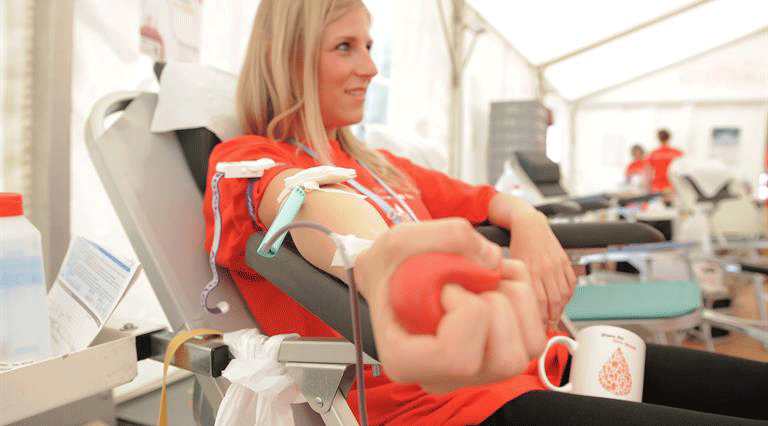
World Blood Donor Day 2011 event at WHO headquarters.
Blood transfusion safety
Nearly 120 million units of blood are donated every year. However, this is not sufficient to meet the global need many patients requiring a transfusion do not have timely access to safe blood. Blood cannot be stored indefinitely, meaning there is a constant need for donations. Regular donations are required to ensure there is always a supply for those in need. Despite global need, donation rates differ around the world and some high-income countries see up to seven times more donations than low-income countries.
Blood transfusions are needed for a wide range of health conditions including anaemia, complications during pregnancy and childbirth, severe trauma due to accidents, and surgical procedures. They are also regularly used for patients with conditions such as sickle cell disease and thalassaemia and for products to treat haemophilia.
Maintaining safe and effective procedures around the collection, storage and use of donated blood is essential. Collectively called haemovigilance, these procedures cover the entire blood transfusion chain and are used to standardize the use of blood in healthcare.
Donated blood is used in many ways beyond whole blood transfusions. Processing can convert it into plasma, red cell concentrates, platelet concentrates and more, with each used for specific cases in health-care delivery. In some cases, this allows a unit of donated blood to meet the needs of more than one patient and is an important aspect of the transfusion train. However, not all countries have facilities to process blood in this way, and only 50 of 173 reporting countries produce plasma-derived medicinal products domestically.
The world’s blood supply comes through over 12 000 blood centres and is donated by three types of people: unpaid volunteers, family members of patients and paid donors. WHO advocates the development of national blood systems based on unpaid volunteers because that group tends to have fewer bloodborne infections. Despite this, many countries continue to receive less than half of blood donations from unpaid volunteers, with much of their blood supply dependent on family donations and paid donors.
The unavailability of timely, safe blood transfusions has led to many otherwise avoidable deaths. A consistent supply of blood is a cornerstone of any health-care system, but this relies on regular donations and effective health-care infrastructure.
Huge gaps exist between low-, middle- and high-income countries regarding blood donation. Of the nearly 120 million units of blood donated each year around the world, 42% are in high-income countries, where just 16% of the global population lives. However, more young people donate in low- and middle-income countries than in high-income countries.
Compounding insufficient collection rates is the inability of many health-care systems to adequately screen donated blood for diseases such as HIV, hepatitis B, hepatitis C and syphilis according to quality system requirements. The inability to test blood can be due in part to the irregular supply of testing kits, particularly in low-income areas. Inadequate testing contributes to the spread of transfusion-transmissible infections, which can compromise the patient’s wellbeing and further strain health-care systems.