A young girl with Buruli ulcer in Benin
Buruli ulcer (Mycobacterium ulcerans infection)
Buruli ulcer is a chronic debilitating disease that mainly affects the skin and sometimes bones. First described by Sir Albert Cook in 1897 in Uganda, it was not until the 1930s that Australian scientists led by Peter MacCallum first succeeded in culturing the organism from lesions of patients from the Bairnsdale region. The name Buruli comes from an area of Uganda where many cases were reported in the 1960s. In Africa, about half of the patients are children under 15 years. In Australia, the average age is around 60 years. In 1998, WHO established the Global Buruli Ulcer Initiative in response to the growing spread of the disease, particularly in West Africa.
Buruli ulcer is caused by Mycobacterium and belongs to the family of bacteria that causes tuberculosis and leprosy. Although the causative organism of Buruli ulcer is an environmental bacterium, the mode of transmission to humans remains unknown. The organism produces a unique toxin – mycolactone – that causes the damage to the skin. Early diagnosis and treatment are crucial to minimizing morbidity, costs and prevent long-term disability.
Symptoms of Buruli ulcer begin with painless nodules and swelling, usually on the arms and legs and sometimes on other parts of the body. These areas can then develop into large ulcers with a white and yellow base. M. ulcerans produces the toxin mycolactone. This has local immunosuppressive properties that enable the disease to progress rapidly with no pain and fever, making early detection difficult. However, if the ulcers are treated quickly, most will heal completely.
If diagnosed late or left untreated, the condition can lead to scarring, permanent disfigurement and disability.
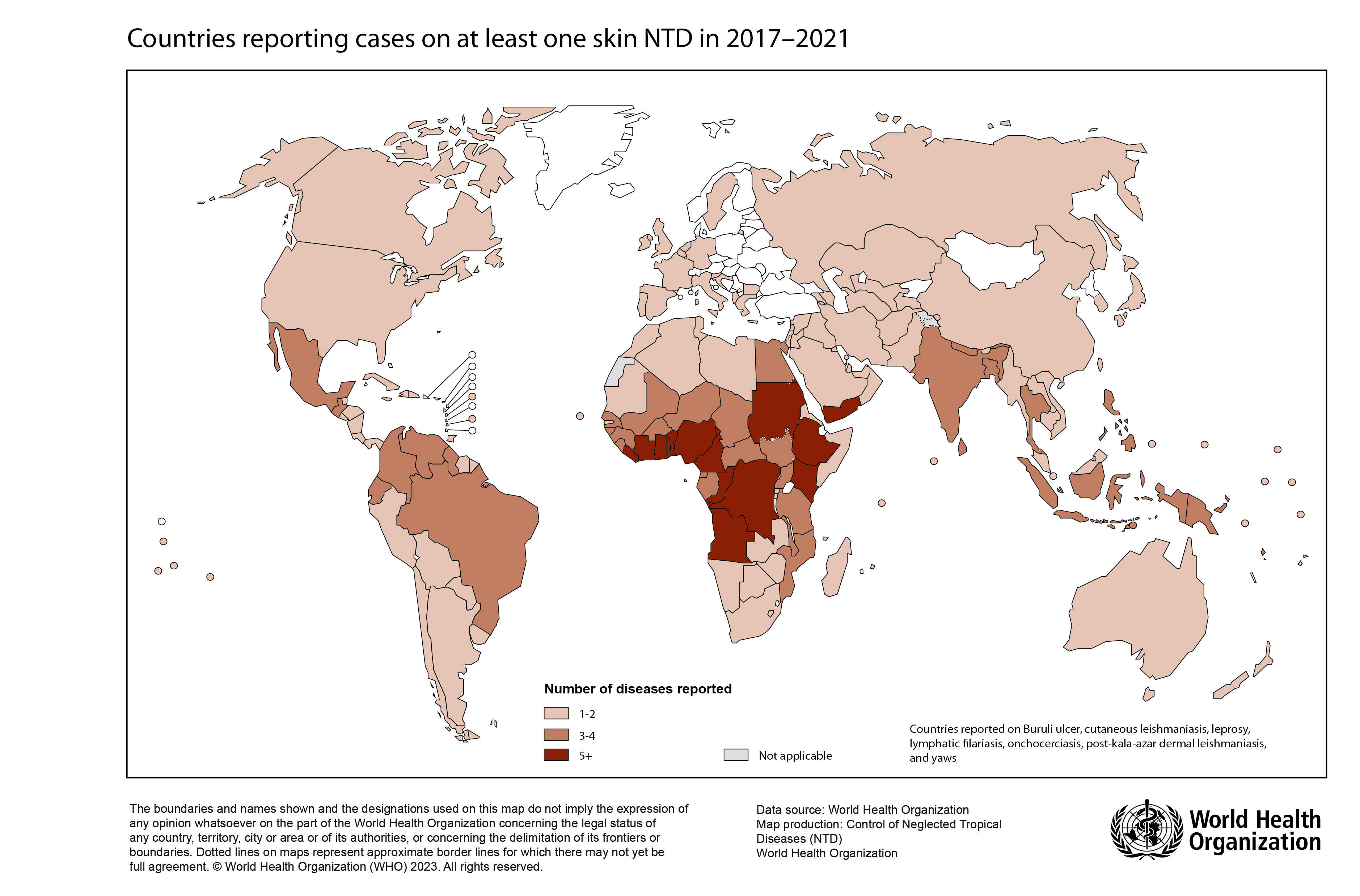
Buruli ulcer has been reported in 33 countries in Africa, the Americas, Asia and the Western Pacific. Most cases occur in tropical and subtropical regions except in Australia, China and Japan. Out of the 33 countries, 14 regularly report data to WHO. The number of annual cases can be found in Global Health Observatory.
Treatment consists of a combination of antibiotics and complementary treatments (under morbidity management and disability prevention/rehabilitation).
Antibiotics:
Current WHO recommendations are rifampicin 10 mg/kg per body weight daily and clarithromycin 7.5 mg/kg per body weight twice daily. Treatment guidance for health workers can be found in the WHO publication Treatment of mycobacterium
ulcerans disease (Buruli ulcer).
Other interventions
In addition to the antibiotics and depending on the stage of the disease, other interventions such as wound care, lymphoedema management, surgery (mainly debridement and skin grafting to speed up healing) and physiotherapy are needed. Psychological support
may also be needed for those with severe disease.
These same interventions are applicable to other neglected tropical diseases, such as leprosy and lymphatic filariasis, so it is important to integrate a long-term care approach into the health system to benefit all patients. The integrated approach to
the control of skin related NTDs provides an opportunity to integrate Buruli ulcer detection and its management with these diseases.