

Marburg hemorrhagic fever is a severe and highly fatal disease caused by a virus from the same family as the one that causes Ebola hemorrhagic fever. Both diseases are rare, but can cause dramatic outbreaks with high fatality. There is currently no specific treatment or vaccine. Two cases of Marburg virus infection were reported in Uganda. One of the people, a miner, died in July, 2007. A public information campaign was developed as well as training courses for local health workers. An international team of experts and scientists meanwhile worked to identify the hosts of the virus and its mode of natural transmission in the environment. They explored the mine cave where the outbreak appeared to have started in search of the reservoir of the Marburg virus. The bats captured from the Kitaka mine were taken to a nearby laboratory, just set up for this purpose. The scientists there worked through the night, taking blood and organ samples to look for Marburg virus antibodies. This photo story documents the combined efforts of WHO and its partners in the Global Outbreak Alert and Response Network to monitor, investigate and control the outbreak of Marburg fever in Uganda.
Marburg virus disease
Marburg virus disease (MVD) is a severe disease with a fatality ratio of up to 88%. This rate can be lower with good and early patient care.
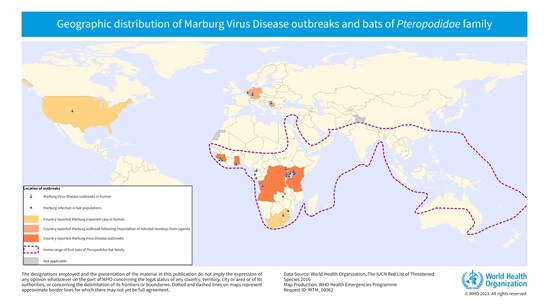
MVD was initially detected in 1967 after two simultaneous outbreaks in Marburg and Frankfurt in Germany, and in Belgrade, Serbia. The outbreak was associated with laboratory work using African green monkeys (Cercopithecus aethiops) imported from Uganda. Subsequently, outbreaks and sporadic cases have been reported in Angola, the Democratic Republic of the Congo, Equatorial Guinea, Ghana, Guinea, Kenya, Rwanda, South Africa (in a person with recent travel history to Zimbabwe), Tanzania and Uganda.
Initially, human MVD infection results from prolonged exposure to mines or caves inhabited by Rousettus fruit bat colonies. Once introduced in the human population, Marburg virus can spread through human-to-human transmission via direct contact (through broken skin or mucous membranes) with the blood, secretions, organs or other bodily fluids of infected people, and with surfaces and materials (e.g. bedding, clothing) contaminated with these fluids.
The incubation period (interval from infection to onset of symptoms) varies from 2 to 21 days.
MVD begins abruptly, with high fever, severe headache and severe malaise. Muscle aches and pains are a common feature. Severe watery diarrhoea, abdominal pain and cramping, nausea and vomiting can begin on the third day. Non-itchy rash have been reported in patients between 2 and 7 days after onset of symptoms.
From day 5 of the disease, patients may develop haemorrhagic manifestations, including fresh blood in vomitus and faeces, bleeding from the nose, gums and vagina. Bleeding at venepuncture sites (where intravenous access is obtained to give fluids or obtain blood samples) can also be observed. Involvement of the central nervous system can result in confusion, irritability and aggression. Orchitis (inflammation of one or both testicles) has been reported occasionally in the late phase of disease.
In fatal cases, death occurs most often between 8 and 9 days after symptom onset, usually preceded by severe blood loss and shock.
Early intensive supportive care including rehydration and treatment of specific symptoms can improve survival.
Currently there are no vaccines or antiviral treatments approved for MVD. There are candidate monoclonal antibodies and antivirals, along with candidate vaccines that can be evaluated in clinical trials.
Diagnosis
It can be difficult to clinically distinguish MVD from other infectious diseases such as malaria, typhoid fever, shigellosis, meningitis and other viral haemorrhagic fevers. Confirmation that symptoms are caused by Marburg virus infection are made using the following diagnostic methods:
- antibody-capture enzyme-linked immunosorbent assay (ELISA)
- antigen-capture detection tests
- reverse transcriptase polymerase chain reaction (RT-PCR) assay
- virus isolation by cell culture in maximum containment laboratories.
Samples collected from patients are an extreme biohazard risk. Laboratory testing on non-inactivated samples should be conducted under maximum biological containment conditions. All non-inactivated biological specimens should be packaged using the triple packaging system when transported nationally and internationally.

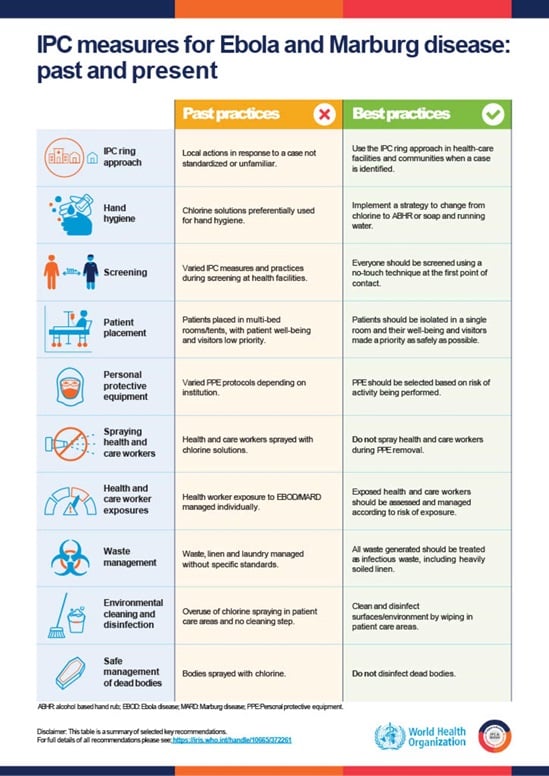
/country-readiness-strengthening-(crs)/health-care-readiness-(hcr)/1eaf7eb99-1099-4c00-ab18-f2b0ffb57d29.tmb-549v.jpg?sfvrsn=78741211_3)
/country-readiness-strengthening-(crs)/health-care-readiness-(hcr)/1.tmb-549v.png?sfvrsn=a94961b3_1)