Mix of outdoor and indoor air pollution.
Air pollution
Air pollution is contamination of the indoor or outdoor environment by any chemical, physical or biological agent that modifies the natural characteristics of the atmosphere.
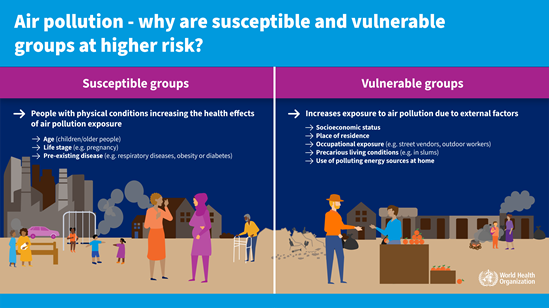
Household combustion devices, motor vehicles, industrial facilities and forest fires are common sources of air pollution. Pollutants of major public health concern include particulate matter, carbon monoxide, ozone, nitrogen dioxide and sulfur dioxide. Outdoor and indoor air pollution cause respiratory and other diseases and are important sources of morbidity and mortality.
WHO data show that almost all of the global population (99%) breathe air that exceeds WHO guideline limits and contains high levels of pollutants, with low- and middle-income countries suffering from the highest exposures.
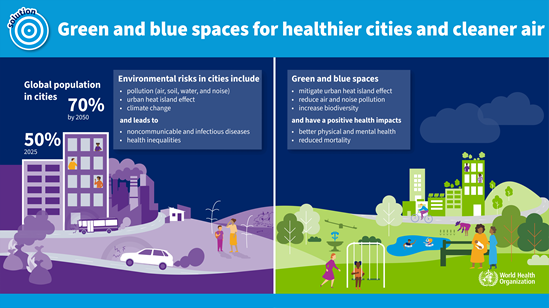
Air quality is closely linked to the earth’s climate and ecosystems globally. Many of the drivers of air pollution (i.e. combustion of fossil fuels) are also sources of greenhouse gas emissions. Policies to reduce air pollution, therefore, offer a win-win strategy for both climate and health, lowering the burden of disease attributable to air pollution, as well as contributing to the near- and long-term mitigation of climate change.
From smog hanging over cities to smoke inside the home, air pollution poses a major threat to health and climate.
Ambient (outdoor) air pollution in both cities and rural areas is causing fine particulate matter which result in strokes, heart diseases, lung cancer, acute and chronic respiratory diseases.
Additionally, around 2.1 billion people are exposed to dangerous levels of household air pollution, while using polluting open fires or simple stoves for cooking fuelled by kerosene, biomass (wood, animal dung and crop waste) and coal.
The combined effects of ambient air pollution and household air pollution is associated with 7 million premature deaths annually.
Sources of air pollution are multiple and context specific. The major outdoor pollution sources include residential energy for cooking and heating, vehicles, power generation, agriculture/waste incineration, and industry. Policies and investments that support sustainable land use, cleaner household energy and transport, energy-efficient housing, power generation, industry, and better municipal waste management can effectively reduce key sources of ambient air pollution.
WHO promotes interventions and initiatives for healthy sectoral policies (including energy, transport, housing, urban development and electrification of health-care facilities), addressing key risks to health from air pollution indoors and outdoors, and contributing to achieving health co-benefits from climate change mitigation policies.
WHO provides technical support to WHO’s Member States in the development of normative guidance, tools and provision of authoritative advice on health issues related to air pollution and its sources.
WHO monitors and reports on global trends and changes in health outcomes associated with actions taken to address air pollution at the national, regional and global levels.
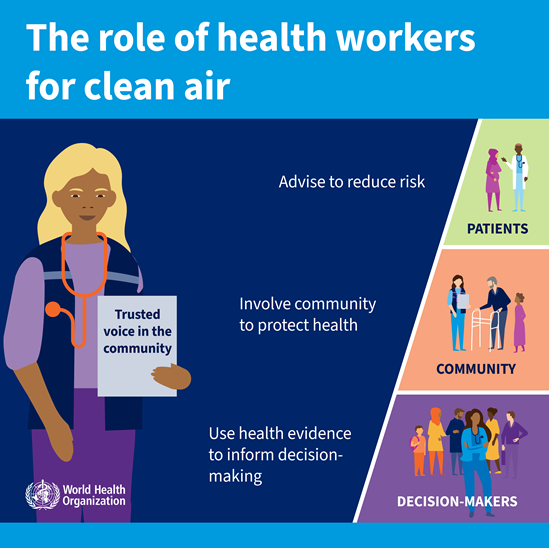
WHO has also developed and implemented a strategy for raising awareness on the risk of air pollution, as well as available solutions that can be implemented to mitigate the risks of exposure to air pollution. Through digital outreach and partnerships, WHO has helped enrich the value proposition of addressing air pollution for health and environment ministries, city governments and other stakeholders from sectors with significant emissions.
/environment-climate-change-and-health-(ech)/air-quality-energy-and-health-(aqh)/module-6-card.tmb-144v.jpg?sfvrsn=140567f0_1)
/environment-climate-change-and-health-(ech)/air-quality-energy-and-health-(aqh)/module-5-card.tmb-144v.png?sfvrsn=83bcff7d_4)
/environment-climate-change-and-health-(ech)/air-quality-energy-and-health-(aqh)/aq-database-june-2026.tmb-144v.png?sfvrsn=fd74cf96_1)
/environment-climate-change-and-health-(ech)/air-quality-energy-and-health-(aqh)/sdg-flyer-air-pollution-energy-and-health.tmb-144v.jpg?sfvrsn=c69d4ae7_1)