Nick Ballon/Wellcome Trust
Extracting snake venom
© Credits

Improving treatment for snakebite patients

WHO supports countries and regions to:

Build capacity for treatment:
Reducing the problem of snakebite envenoming begins by improving education about its risk and providing training to medical staff and health-care workers in affected countries.
WHO supports the development of standard treatment guidelines for medical professionals and health-care workers. WHO also participates in the creation of additional training resources for regions and countries adapted to service delivery environments and availability of local resources.

Provide early access to safe, affordable and effective antivenoms:
Improving access to antivenoms is essential to minimize morbidity and mortality and is a major component of WHO’s strategy to prevent and control snakebite envenoming. 
Antivenoms remain the only treatment available to prevent or reverse the effects of snakebite envenoming when administered early and in adequate therapeutic doses. They are included in WHO’s Model List of Essential Medicines.

Strengthen diagnostics tests and tools:
Developing new point-of-care diagnostic tools has considerable potential to enhance surveillance of snakebite envenoming by enabling retrospective identification in pathology samples of venom immunotypes from various species of snakes. 
Strengthened diagnostic tests and tools can improve the reporting of snakebite envenoming and assist in determining optimal antivenom needs for regions.

Raise awareness of snakebite rehabilitation:
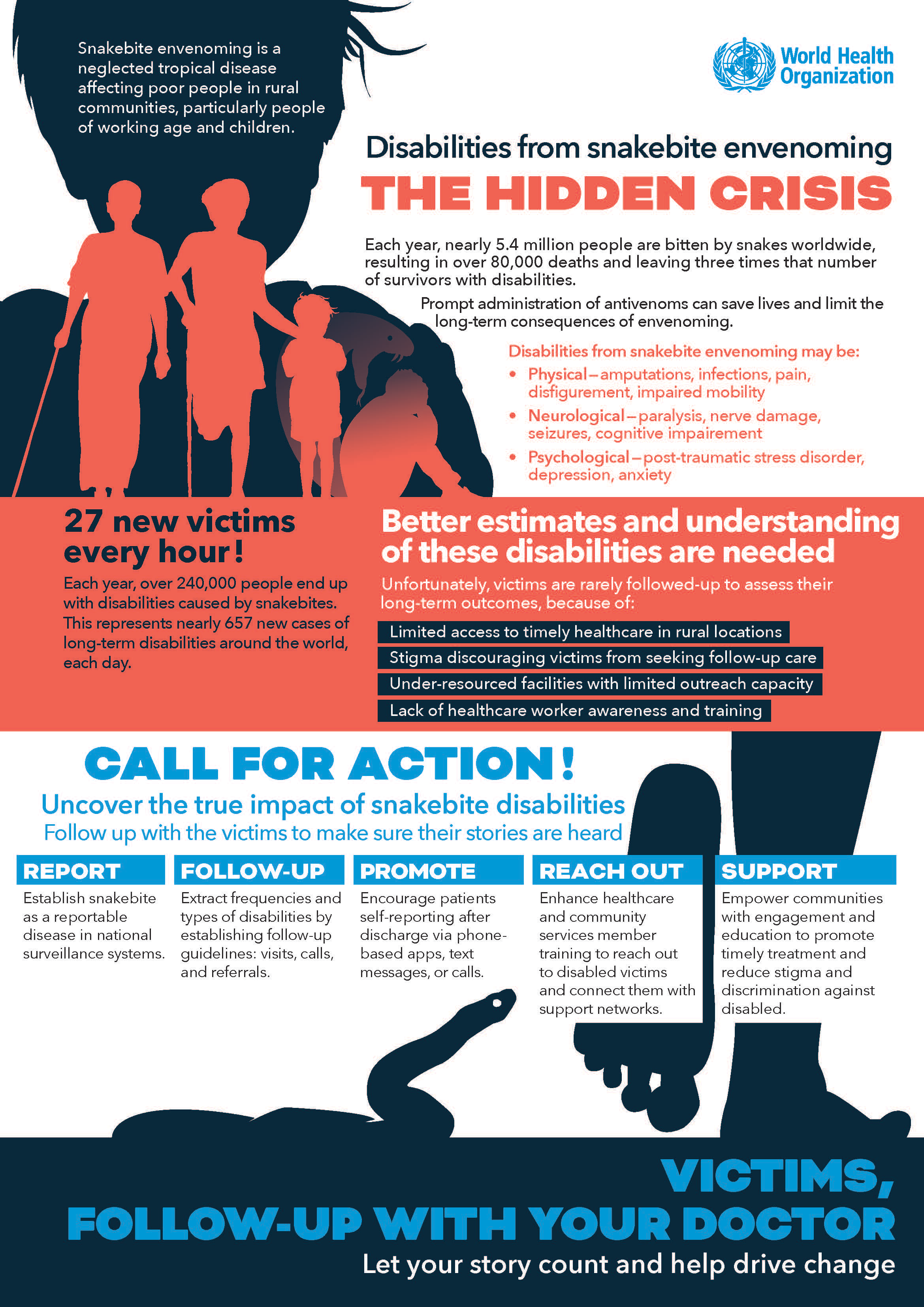
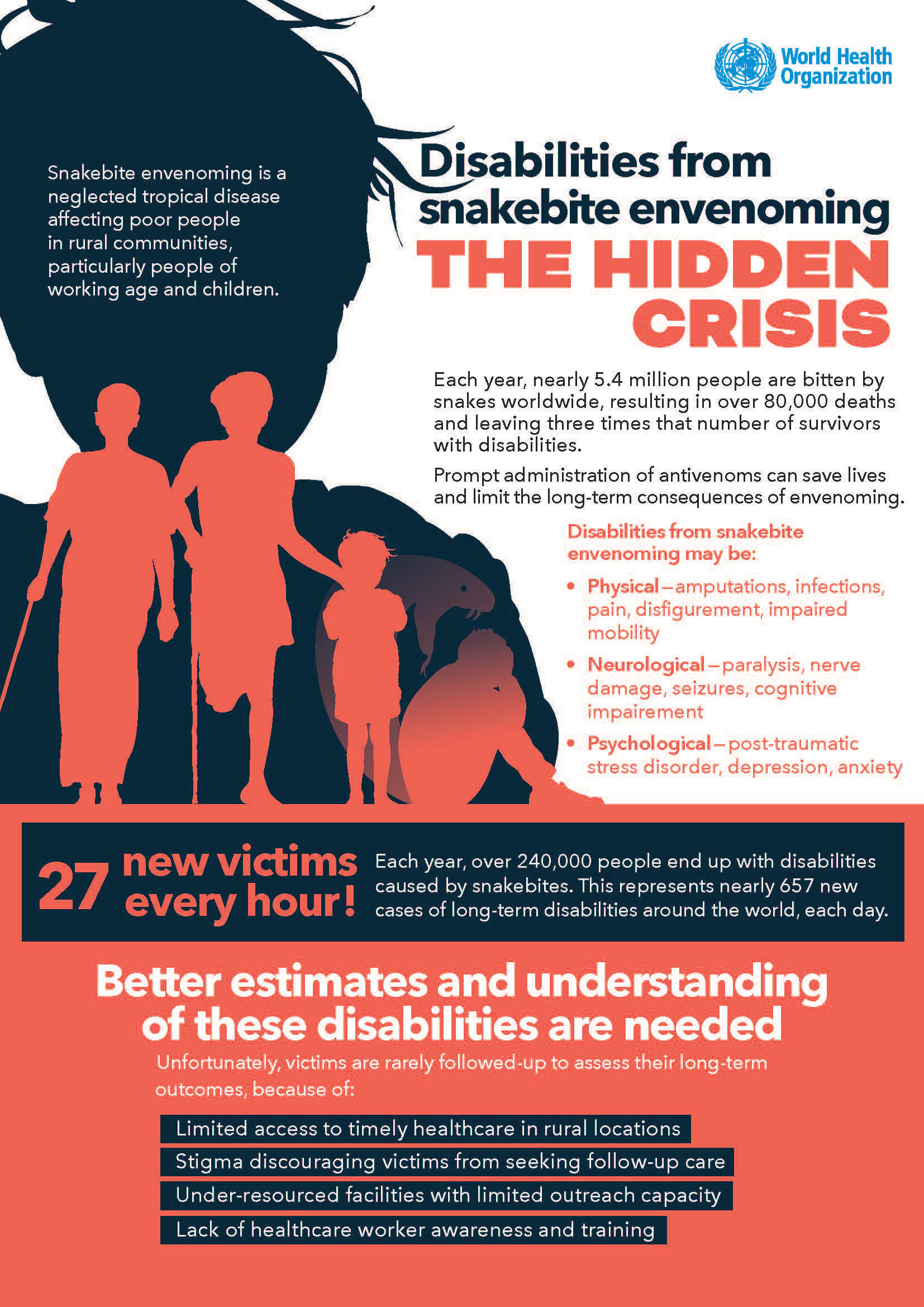
Increasing awareness of snakebite envenoming as an important public health problem with organizations that work with disabled people in the developing world is essential to improving access and equity for victims. Snake bites can cause a variety of disabilities potentially leading to substantial loss of limb use or even amputation. In some countries victims become mired in poverty and may be socially ostracized. 


Snakebite - test

Currently, only one commercial diagnostic test available.

Up to 138 000 deaths

estimated per year

Almost 7400 people every day are bitten by snakes, and 220–380 people die as a result.

Read more

400 000

snakebite envenoming victims left with permanent disabilities each year

News

All →

Related activities

Addressing antivenoms issues

Addressing antivenoms issues

Al Jazeera
Sri Lanka antivenom leap forward
© Credits

Overview

The use of antivenom is one of the main control measures for snakebite envenoming. The effectiveness of any antivenom can be affected by a range of issues. Ensuring that the right venoms are used to produce the immune plasma from which antivenom is made, and that the horses or other animals used to generate this antibody-rich plasma are healthy, well cared-for, and receive excellent veterinary supervision can make a big difference to the quality and effectiveness of the final product. Strengthening the capacity of antivenom manufacturers in these and other areas of production is essential. Likewise, building strong regulatory systems that can provide robust governance of these unique drugs is also essential. WHO is already working with manufacturers and regulatory agencies to effect change.

At the centre of the control strategy is the challenge of improving access to high-quality antivenoms that are suitable for use in regions in which they are marketed, and developing mechanisms to increase their availability through collective bulk purchasing by consortia (governments, nongovernmental organizations, aid donors) or via other novel supply and distribution schemes. Designing distribution pathways and systems to ensure that antivenoms are available at locations close to where bites occur is also vital. The majority of people who need antivenom cannot afford the current cost of most products. Financing antivenoms in such a way that no patient or their family has to pay more than an equitably nominal cost for treatment is another step towards increased accessibility.


Publications

All →
Target product profiles for small molecule or engineered antibody therapeutics for treatment of snakebite envenoming
We describe the first WHO public-benefit Target Product Profiles (TPPs) for the treatment of snakebites using novel therapeutics. The objective of these...
A dual battle: rabies and snakebite envenoming in South-East Asia

Rabies and snakebite envenoming (SBE) are endemic in most countries in the WHO South-East Asia Region (SEAR), which bears the highest global burdens of...

Progress in snakebite envenoming 
data reporting: challenges and 
opportunities

BackgroundSnakebite envenoming represents a critical yet neglected global health issue, disproportionately affecting impoverished, rural populations...

Multimedia