
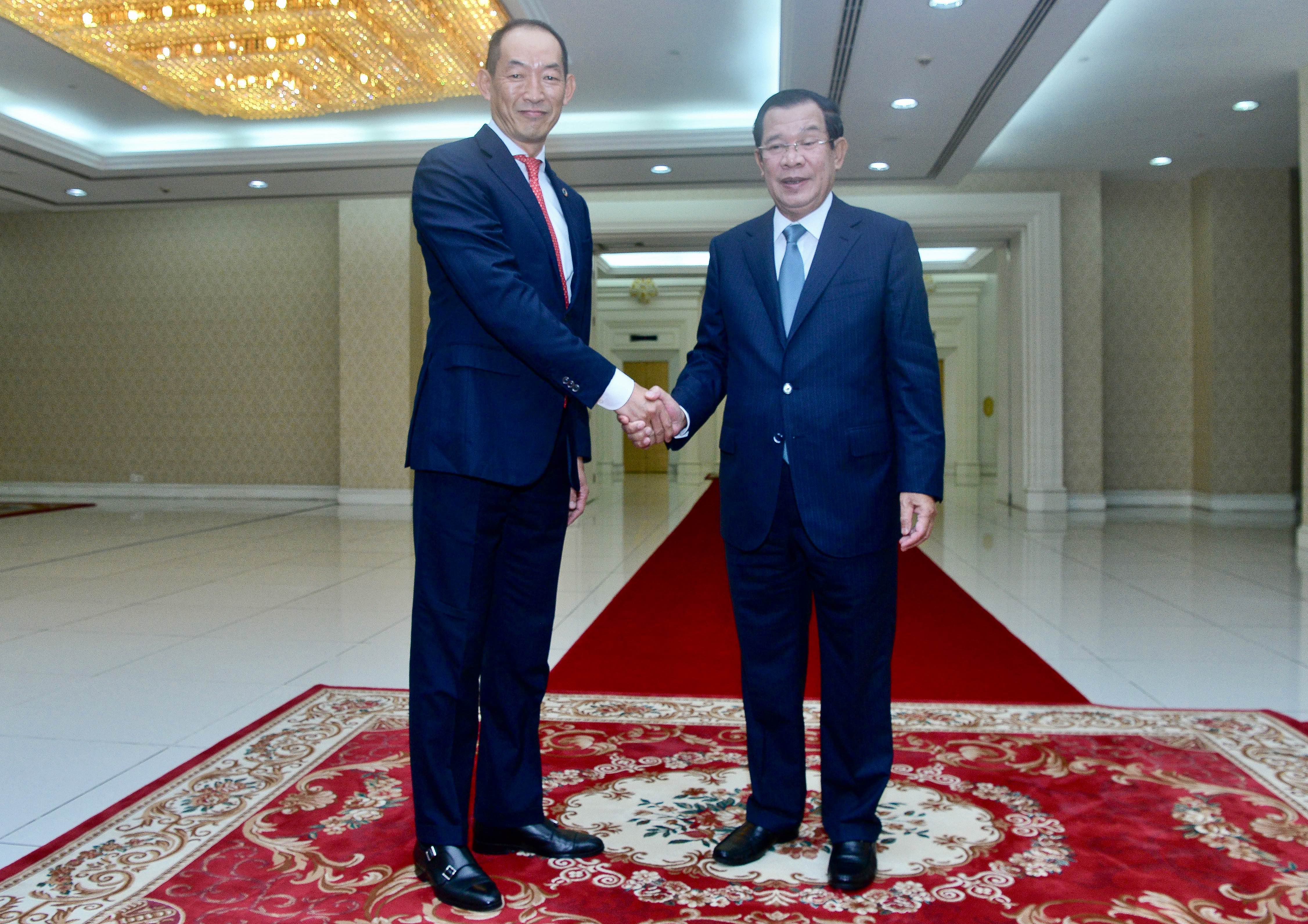
Health and economic prosperity are closely interlinked and making sure that populations in the Western Pacific Region remain healthy makes strong financial sense. This was the message from Dr Takeshi Kasai, WHO Regional Director for the Western Pacific, when he visited Cambodia in late August to meet with Samdech Hun Sen, Prime Minister of Cambodia, other senior leaders in the Royal Government of Cambodia, and address a regional health ministers meeting.
“Health is not just a necessary cost to be borne by the economy; instead it is increasingly recognized that health is a vital investment that builds human capital, reduces poverty, provides employment and enables health and social development,” said Dr Kasai when he met Samdech Hun Sen at the Peace Palace on 26 August.
Dr Kasai commended Samdech Hun Sen when he pointed out the significant strides Cambodia had made in health over the last few decades thanks to the Kingdom’s strong economic development and government leadership. Dr Kasai added during his meeting with Samdech Hun Sen that he noticed that the Kingdom has developed rapidly, compared to his earlier visits to the Kingdom.
“Health achievements under Samdech Prime Minister’s leadership are impressive. He is so committed to making Cambodia healthier and he is a strong champion for tobacco control,” said Dr Kasai. In turn, Samdech Hun Sen shared his personal commitment on how he took the lead on tobacco control and his efforts to reduce tobacco consumption in Cambodia. Samdech Hun Sen also expressed his pleasure over the close cooperation between the Kingdom and WHO.
“Through this good cooperation, Cambodia has successfully dealt with serious diseases such as polio, measles, avian influenza, HIV/AIDS which the Kingdom has effectively contained and even reduced,” said Samdech Hun Sen.
At a later meeting, Dr Kasai congratulated H.E. Dr Aun Pornmoniroth, Deputy Prime Minister and Minister of Economy and Finance, on Cambodia’s strong economic performance in the last decade as one of the fastest growing economies in the world.
Dr Kasai recognized the prioritization that the Ministry has given to health and promised WHO’s full support for Cambodia to help fulfill its aspiration to achieve universal health coverage (UHC) as the Kingdom moves towards becoming an upper-middle income country by 2030.
At a working dinner with H.E. Professor Dr Mam Bunheng, Minister of Health (along with his senior team), Dr Kasai recognised Cambodia’s progress in the path towards eliminating malaria.
“The progress on eliminating multi-drug resistant Plasmodium falciparum is commendable and achieving this would be a major contribution to global health,” said Dr Kasai. Dr Kasai also offered WHO’s full support to the Ministry’s crucial upcoming strategic planning period.
At the end of Dr Kasai’s visit, he took the opportunity to meet with all of the Health Ministers of the ASEAN region at their meeting in Siem Reap, hosted by the Royal Government of Cambodia. The theme of the ASEAN Health Ministers Meeting was “Sustainable Health Financing towards Health for All”.
In his address to the meeting, Dr Kasai urged ASEAN Health Ministers to continue supporting the development of strong and resilient health systems. “We are facing a crucial window of opportunity to transform our health systems to be fit for the future – ready for an ageing population and to beat non-communicable diseases,” he said.
“Health is not a cost but an investment and primary health care is the key,” stressed Dr Kasai.
Dr Kasai was also able to attend the Cambodia National Assembly Forum on “The Role of Parliamentarians to achieve NCDs-related SDGs”, which considered how parliament members could take forward Cambodia’s National Multisectoral Action Plan for the Prevention and Control of Noncommunicable Diseases 2018-2027.
Dr Kasai urged Cambodian leaders present to tackle risk factors such as smoking, strengthen health systems focusing on the primary health care approach to address NCDs, and mobilize sustainable financing to increase NCD efforts.