
Science Council
About us
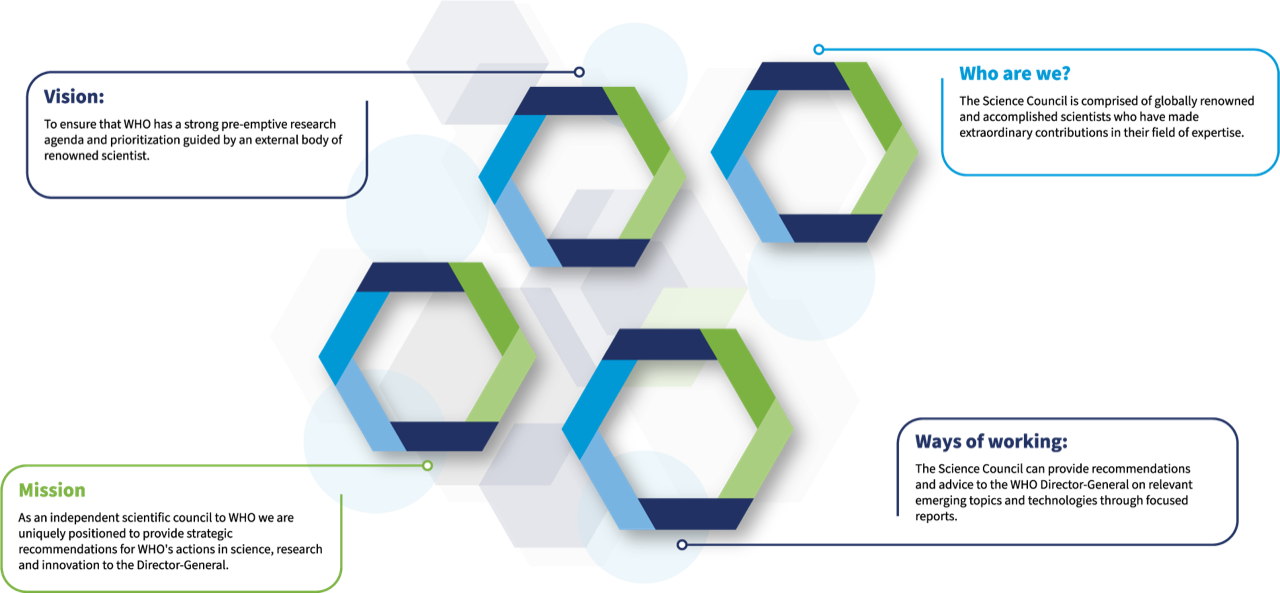
The World Health Organization's Science Council acts as the voice of scientific leadership directly advising the Director-General about high-priority scientific issues, and advances in science and technology that could directly impact global health. The Science Division will facilitate the Council’s activity in setting the top WHO science, research and innovation priorities, independently from programme specifics, and focusing on areas where gaps exist.
The Science Council was established in April 2021 by the Director-General of the World Health Organization to provide guidance on the science and research strategy of the organization.
The Science Council has the following functions:
- Evaluate urgent, high priority scientific issues and provide input and guidance on translating them to public health impact in furtherance of WHO’s mission;
- Identify current and new science and technology issues that WHO needs to address, including global health threats, and new advances with a potential for direct or indirect impact on global health;
- Provide strategic orientation to WHO’s actions in science, research and innovation;
- Participate in the rapid and confidential review of WHO normative products, when requested by the Director-General; and
- Undertake other duties and functions consistent with these Terms of Reference, when requested by the Director-General
News
All →Call for experts
Videos
All →

Publications
All →Advancing the responsible use of digital technologies in global health: a report of the WHO Science Council
This report presents the recommendations of the WHO Science Council to reduce inequities and advance the responsible use of digital technologies in global...
Accelerating access to genomics for global health: promotion, implementation, collaboration, and ethical,...
This publication presents the recommendations of the WHO Science Council to the Director-General on accelerating access to genomics for global health....
Events
Meeting reports
WHO Science Council meeting, Geneva, Switzerland, 30-31 January 2024: report
WHO Science Council meeting, Geneva, Switzerland, 29-30 June 2023: report
Members
Science Council is currently comprised of 21 members, who serve in their
personal capacity and represent a broad range of disciplines encompassing many
aspects of science, ranging from basic research to public health implementation
science.
Members are recruited and selected as acknowledged experts from around the
world in the fields of basic science, translational and clinical research, social
sciences, epidemiology and public health.
Science Council Secretariat
Anna Laura Ross
Head of the secretariat, Science Council
Veronique Bruniquel
Administrative assistant to the Science Council