Family planning services in the community
Contraception
Family planning allows people to attain their desired number of children, if any, and to determine the spacing of their pregnancies. It is achieved through use of contraceptive methods and the treatment of infertility.
Contraceptive information and services are fundamental to the health and human rights of all individuals.
The prevention of unintended pregnancies helps to lower maternal ill-health and the number of pregnancy-related deaths. Delaying pregnancies in young girls who are at increased risk of health problems from early childbearing, and preventing pregnancies among older women who also face increased risks, are important health benefits of family planning.
By reducing rates of unintended pregnancies, contraception also reduces the need for unsafe abortion and reduces HIV transmissions from mothers to newborns. This can also benefit the education of girls and create opportunities for women to participate more fully in society, including paid employment.
An estimated 164 million women of reproductive age have an unmet need for contraception. Reasons for this include:
- limited access to contraception
- a limited choice of methods
- a fear or experience of side-effects
- cultural or religious opposition
- poor quality of available services
- gender-based barriers.
It is important that family planning is widely available and easily accessible through trained health workers to anyone who is sexually active, including adolescents.
There are many cadres of health care workers who are trained to provide (where authorised) locally available and culturally acceptable contraceptive methods including doctors and midwives. Other trained health workers, for example community health workers, also provide counselling and some family planning methods, for example pills and condoms. For methods such as sterilization, women and men need to be referred to a clinician.
The Sustainable Development Goals set for 2030 will need to ensure that sexual and reproductive health services are widely available and used. This includes supporting contraceptive services through effective government policies and the provision of high-quality services for individuals.
WHO is working to promote contraception by producing evidence-based guidelines on safety and service delivery of contraceptive methods and on ensuring human rights in contraceptive programmes. It is also developing quality standards and providing pre-qualification of contraceptive commodities.
WHO assists countries to adapt and implement these tools to strengthen contraceptive policies and programmes. Additionally, WHO participates in developing new contraceptive technologies to and leads and conducts implementation research for expanding access to and strengthening delivery contraceptive information and services.
Various contraceptive methods are effective and safe, depending on correct use. This summary covers widely used options. For comprehensive information and guidance, consult Family Planning: A Global Handbook for Providers.
Hormonal Contraceptive Methods
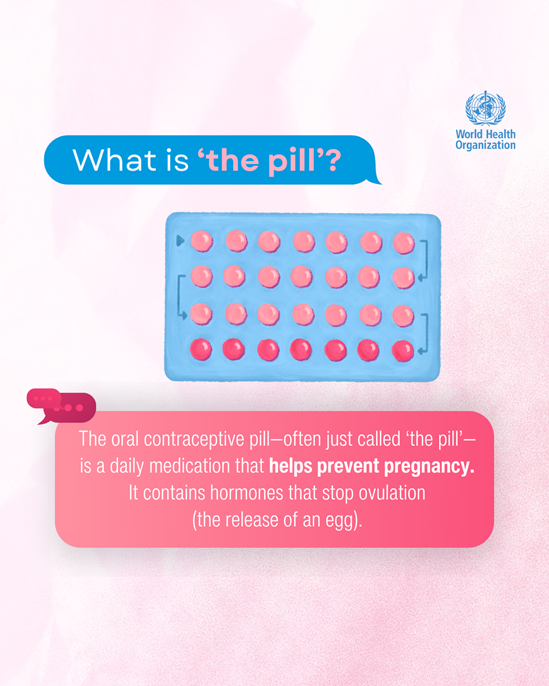
Hormonal contraceptives prevent pregnancy by stopping ovulation, thickening cervical mucus, and thinning the uterine lining. They are effective, reversible, and come in several forms.
- Oral Contraceptives (The Pill)
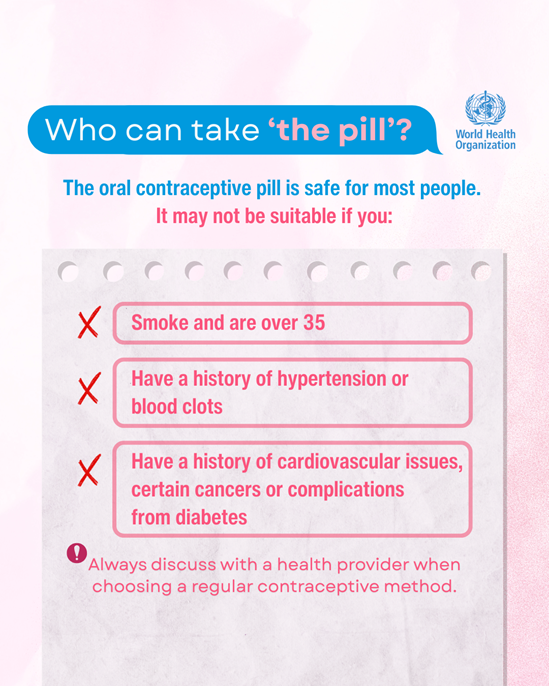
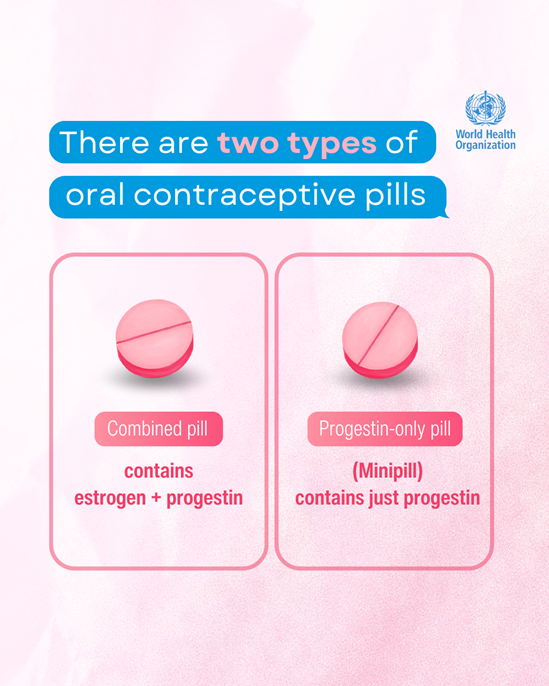
A pill that contains either both estrogen and progestin or only progestin. It is taken orally each day. Effectiveness depends on consistent use and stops immediately when discontinued. - Hormonal IUD
A small device that releases progestin and is placed in the uterus by a healthcare provider. It remains effective for 3 to 5 years, depending on the type. - Vaginal Ring
A flexible ring that releases estrogen and progestin. It is inserted into the vagina by the user, left in place for 3 weeks, then replaced monthly. - Implants
Thin rods placed under the skin of the upper arm that release progestin. Inserted by a healthcare provider, they provide protection for 3 to 5 years. - Injectables
An injection of progestin given by a provider, usually into the arm or buttock. Depending on the type, it protects against pregnancy for 2 or 3 months.
These options allow individuals to choose a method that best fits their health, lifestyle, and preferences with guidance from a healthcare provider.
Non-Hormonal Contraceptive Methods
- Copper IUD
A hormone-free device wrapped in copper that prevents fertilization. It is inserted into the uterus by a healthcare provider and remains effective for up to 12 years. - Condoms
Barrier methods worn on the penis (male condom) or placed in the vagina (female condom) to block sperm and protect against STIs. They are used during each act of sex and offer protection only when in place. - Vasectomy or Female Sterilization
A minor surgical procedure that blocks the tubes carrying sperm. Female Sterilization is surgical procedure that blocks the fallopian tubes to prevent pregnancy. Both should be carried out by a healthcare provider and are permanent methods and intended for those who do not want future children.
Emergency contraception
Methods used after unprotected sex to prevent pregnancy, including pills or a copper IUD. Pills are taken orally, and the IUD is inserted by a healthcare provider. All options must be used within five days to be effective.