
Date: 12 December 2025
Time: 14:00 – 15:00 IST
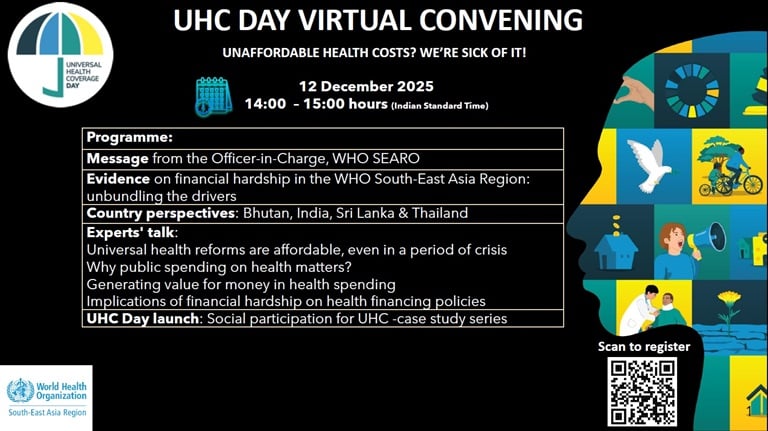
Universal Health Coverage (UHC) Day on 12 December is the annual rallying point for the global movement for health for all. It marks the anniversary of the United Nations’ historic and unanimous endorsement of UHC in 2012.
This year’s theme, "Unaffordable health costs? We’re sick of it!" reflects widespread discontent and a fundamental moral imperative: financial protection is not optional but constitutes a core pillar of UHC, as well as a prerequisite for sustained social and economic progress. It underscores the human realities underlying these statistics, reminding government decision-makers that unaffordable health expenditures are impoverishing communities, exacerbating poor health and impeding progress across the full spectrum of the Sustainable Development Goals.
Countries in the WHO South-East Asia have demonstrated commitments, often accompanied with bold reforms, and recorded notable progress to advance financial protection in health. The proportion of the population spending more than 40% of their household discretionary budget on health out-of-pocket consistently decreased from 38.4% in 2010 to 34.7% in 2015, reaching 30.9% in 2022.
However, the pace of progress has not been fast enough to achieve the minimum essential global UHC targets by 2030, nor meet the regional and country aspirations. The proportion of the population incurring large but not impoverishing OOP health spending continued to rise from 6.7% in 2010 to 8.6% in 2022, with continued deterioration in financial hardship for the lowest consumption quintiles. This reflects the continued detrimental impact of out-of-pocket expenditures across a wide cross-section of the population in our countries, impeding UHC progress. Our country-level analyses reveal that a significant proportion of households in South-East Asia face financial hardship due to high out-of-pocket expenditures on medicines and outpatient care, with the burden most acute among poorer and rural populations.
This virtual event commemorating UHC Day serves both as a celebration of achievements and a reflection on ongoing challenges. It provides a platform to examine the pressing issues and challenges, facilitate dialogue and awareness, and garner renewed commitment to improve financial protection in health, to advance progress towards UHC.
Objectives
- Present global and regional trends on financial hardship due to health spending, based on the latest GMR. Highlight disaggregated analyses of OOP and financial hardship indicators–by income, gender, geography, and service type–to understand inequities.
- Discuss country experiences and strategies to strengthen financial protection.
- Reflect on policy actions for advancing UHC and ensuring no one faces financial hardship for seeking care.
Key messages
- While composite financial hardship have gradually declined, the proportion of the population incurring large but not impoverishing OOP health spending continued to rise in the WHO SEAR, from 6.7% in 2010 to 8.6% in 2022
- Continued deterioration in financial hardship for the lowest consumption quintiles.
- The poorest populations, people living with older members, in multigenerational families, in rural areas face the highest rates of financial hardship
- OOP spending on medicines is a major driver of OOP spending in many countries, for multiple reasons including growing chronic conditions. The reasons for this vary in each country and hence requires specific analysis, but typically include one or a combination of i) widespread self-treatment through direct contact with pharmacies ii) related to this, low availability of medicines under public coverage schemes iii) high prices for numerous reasons e.g. market structure, procurement policies iv) growing levels of consumption (e.g. increase in chronic conditions, prescribing practices/ provider incentives for supplier-induced demand).
- There are several ways in which health financing systems can help to protect patients against high OOP spending (e.g. robust pre-payment systems, well-crafted benefit packages aligned with available revenues, appropriately designed co-payment policies (where relevant), strategic purchasing strategies.
- Broader health system factors e.g. model of care/PHC emphasis, and non-health system factors e.g. presence of social protection systems, also have an impact.
Agenda
Moderator: Jayendra Sharma
Opening remarks: Catherina Boehme / Manoj Jhalani, WHO-SEARO
Presentation: Financial hardship in the WHO South-East Asia Region: unbundling the drivers – Maneeta Jain & Catherine Korachais, WHO SEARO/HQ
Country perspective/commitment
- India – recent measures to enhance financial protection
- Sri Lanka – addressing financial protection through a new health financing strategy
- Bhutan – mobilizing multi-sectoral actions for financial protection
- Thailand – sustainable, adequate, fair, and efficient (S-A-F-E) UHC financing
Panel talk
- Universal health reforms are affordable, even in a period of crisis – TBC
- Why public spending on health matters? –Rob Yates, LSE
- Generating value for money in health spending – Sonalini Khetrapal, ADB
Closing: Implications for health financing in the region – Alaka Singh. WHO-SEARO
UHC Day launch: Social participation for UHC case study series – Manoj Jhalani, WHO-SEARO