Summary
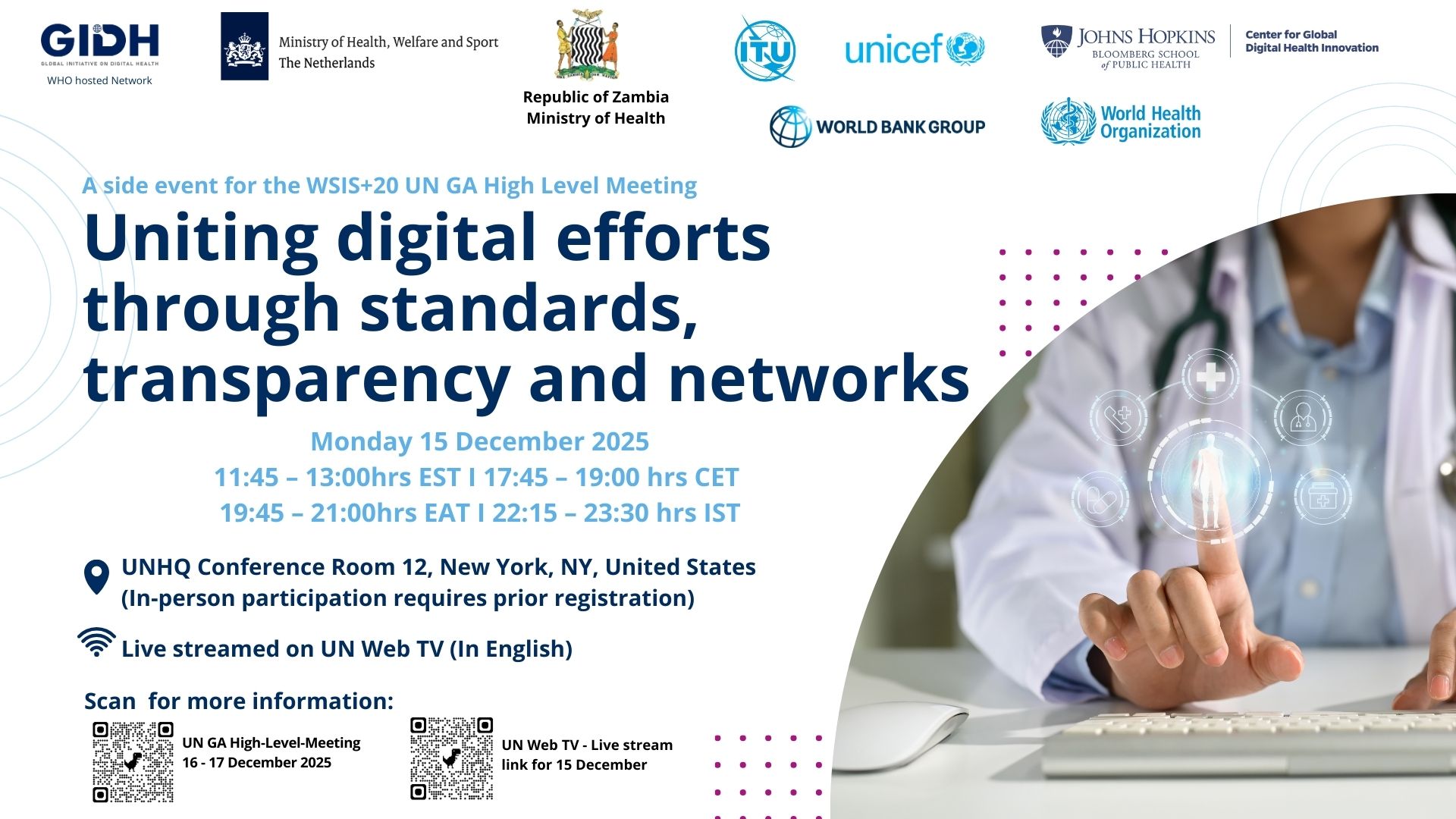
On the margins of the World Summit on the Information Society (WSIS)+20 High-Level Meeting of the United Nations General Assembly 16 to 17 December 2025, WHO, the Global Initiative on Digital Health, Ministry of Health, Welfare and Sport in The Netherlands, the Republic of Zambia Ministry of Health, ITU, UNICEF, the World Bank, and Johns Hopkins University Bloomberg School of Public Health Center for Global Digital Health Innovation and others will come together to share examples from the global level to the last mile of united efforts to future proof health systems for a digital public infrastructure (DPI)-based transformation that enables person-centered health systems that leave no one behind. The event will be live streamed on UN Web TV through the link available on this page. In-person participation requires prior registration.
Description
During 78th session of the World Health Assembly in May 2025, Member States endorsed the renewal of the Global Strategy on Digital Health until 2033, highlighting priority areas such as digital and data governance, interoperability, digital infrastructure, equitable access to patient-centric technologies, digital health literacy and workforce capacity development. A digital health transformation based on Digital Public Infrastructure (DPIs), can enable health systems to boost access and quality of health services, leveraging foundational infrastructure such as digital ID from CRVS. When combined with health specific DPIs (e.g. health facility registries), foundational DPIs such digital payment and data exchange can enhance the quality, efficiency, and reach of health services, paving the way for person-centered care and bridging the digital divide. However, despite this potential, investments in DPIs remain limited.
This session will bring together Member States, UN agencies and academia to share examples from the global level to the last mile of united efforts to future proof health systems for a DPI-based transformation. Participants will be given tools and opportunities to engage in activities that help countries and partners avoid vertical investments that do not promote or enable data exchange.