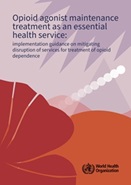
WHO, the International Network on Health and Hepatitis in Substance Users (INHSU) and Médecins du Monde (MdM) are co-organizing this webinar to launch the WHO technical document, Opioid agonist maintenance treatment as an essential health service: implementation guidance on mitigating disruption of services for treatment of opioid dependence.
Date and time
Wednesday, 17 December 2025 | 11:00–12:15 (CET)
The webinar will be in English.
Webinar objectives
This session will present WHO recommendations for uninterrupted Opioid agonist maintenance treatment (OAMT) access, discuss the impact of service disruptions, and highlight global efforts to ensure life-saving interventions for people who use drugs are maintained.
The webinar is intended for service planners, providers, policymakers, communities of people with living and lived experience, and stakeholders involved in treatment and overdose prevention programs.
Speakers
- Tereza Kasaeva, Director, Department for HIV, Tuberculosis, Hepatitis, and Sexually Transmitted Infections, WHO;
- Anja Busse, Unit Head, Drugs, Alcohol and Addictive Behaviours, WHO;
- Anton Basenko, Executive Director, International Network of People who Use Drugs;
- Peter Vickerman, Professor of Infectious Diseases Modelling, University of Bristol;
- Michel Kazatchkine, Commissioner, Global Commission on Drug Policy; and
- Dévora Kestel, Director a.i., Noncommunicable Diseases and Mental Health, WHO.
Moderator
Annette Verster, harm reduction expert.
Background
OAMT for people with opioid dependence is proven to be safe and effective in addressing a broad range of health and social issues, and should be maintained even during crises or emergencies. It should be integrated within national health systems and strategies to ensure stable funding, reliable access, and equitable care for all who need it.
WHO's new guidance document advocates for uninterrupted access to OAMT and support to countries experiencing service disruptions in opioid dependence treatment. It is intended for use by stakeholders involved in the planning, financing, and delivery of treatment services for opioid dependence and the prevention of opioid overdose.