
Since the term spurious/substandard/falsely-labelled/falsified/counterfeit health products first emerged in the international arena three decades ago, the problem has only become more complex. Once regarded as a problem primarily for low- and middle-income countries, the scourge of SF products has now become global, as a result of globalization, rapidly expanding free trade and the Internet.SF medical products cause death, hospitalisations and disabilities. However in the vast majority of cases they just fail to treat the patients’ disease, leading to the same detrimental outcomes, whilst making these incidents difficult to detect by healthcare professionals and governments.
Unregulated websites are a key source of SF products. Perhaps more worrying though, is that incidents of SF medical products are frequently reported to WHO from hospitals, clinics and pharmacies within the regulated supply chain: precisely where patients should have full confidence in the safety and effectiveness of the medicines they receive.
WHO, Member States, regional groups, international organizations, civil society, and industry widely recognize this issue as a significant and unacceptable threat to human health. In 2012, the Sixty-fifth World Health Assembly re-established a clear mandate to tackle SF Medical Products, as part of WHO’s fundamental role in protecting public health (resolution WHA65.19). It calls on WHO to support Member States in building capacity to prevent and control SSFFC medical products, and established a Member State mechanism focused on cooperation collaboration and capacity building in relation to SF products.
SF products: an ill wind
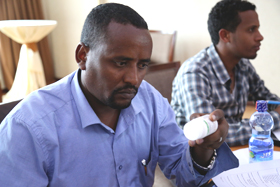
Medicines regulators like Abdela Kasso Rari, the Director of Medicine Facility Inspection in Ethiopia’s Food, Medicines and Health Care Administration and Control Authority, recognize the value of collaboration over the issue. “No country is free from medical products counterfeiting which is an act of economic sabotage,” he says. “It is an ill wind that blows to everyone.”
But while the threat of SF products is acknowledged, detection poses huge challenges. Evidence on the scope of the problem is poor. There is no accurate global or regional assessment of the scope, scale and harm caused. Some excellent surveys have been conducted in various different parts of the world but they are often short term, restricted to specific therapeutic categories or limited geographic areas.
Collaborating to fight SF
Eleven African countries recently moved to improve their technical capacity to tackle SF products, in a workshop in Ethiopia conducted by the WHO Safety and Vigilance team, in collaboration with the US Pharmacopeial Convention Promoting the Quality of Medicines programme, and supported by the EU/ACP/WHO Renewed Partnership. These countries are now part of a growing global network of 95 Member States who have reported to date just under 900 suspect medical products to the WHO Global Surveillance and Monitoring System against SF medical products, which was launched in 2013 following consultation with Member States. They contribute to building a reliable, qualitative and quantitative database on the global scope, scale and harm caused by SF medical products.
Mr Rari says the workshop helped participants understand the importance and benefit of reporting incidence involving SF; providing training on submitting reports of SF using the new rapid alert form and encouraged the establishment of networks of relevant stakeholders within their respective countries in order to capture reports of SF.
“National measures to tackle the issue of SF medical products are important, regional efforts are key, and inter-regional connectivity is required to protect and maintain the health and economic security of countries,” he says. “It’s also very important that the first step towards combating counterfeiting is getting people to know that it exists with all its consequent deleterious effects, so that all the citizens become part of the regulation.”