
Coronavirus disease (COVID-19): How is it transmitted?
23 December 2021 | Questions and answersThe English version was updated on 23 December 2021.
We know that the disease is caused by the SARS-CoV-2 virus, which spreads between people in several different ways.
Current evidence suggests that the virus spreads mainly between people who are in close contact with each other, for example at a conversational distance. The virus can spread from an infected person’s mouth or nose in small liquid particles when they cough, sneeze, speak, sing or breathe. Another person can then contract the virus when infectious particles that pass through the air are inhaled at short range (this is often called short-range aerosol or short-range airborne transmission) or if infectious particles come into direct contact with the eyes, nose, or mouth (droplet transmission).
The virus can also spread in poorly ventilated and/or crowded indoor settings, where people tend to spend longer periods of time. This is because aerosols can remain suspended in the air or travel farther than conversational distance (this is often called long-range aerosol or long-range airborne transmission).
- People may also become infected when touching their eyes, nose or mouth after touching surfaces or objects that have been contaminated by the virus.
Further research is ongoing to better understand the spread of the virus and which settings are most risky and why. Research is also under way to study virus variants that are emerging and why some are more transmissible. For updated information on SARS-CoV-2 variants, please read the weekly epidemiologic updates.
Whether or not they have symptoms, infected people can be contagious and the virus can spread from them to other people.
Laboratory data suggests that infected people appear to be most infectious just before they develop symptoms (namely 2 days before they develop symptoms) and early in their illness. People who develop severe disease can be infectious for longer.
While someone who never develops symptoms can pass the virus to others, it is still not clear how frequently this occurs and more research is needed in this area.
Both terms refer to people who do not have symptoms. The difference is that ‘asymptomatic’ refers to people who are infected but never develop any symptoms, while ‘pre-symptomatic’ refers to infected people who have not yet developed symptoms but go on to develop symptoms later.
Yes, any situation in which people are in close proximity to one another for long periods of time increases the risk of transmission. Indoor locations, especially settings where there is poor ventilation, are riskier than outdoor locations. Activities where more particles are expelled from the mouth, such as singing or breathing heavily during exercise, also increase the risk of transmission.
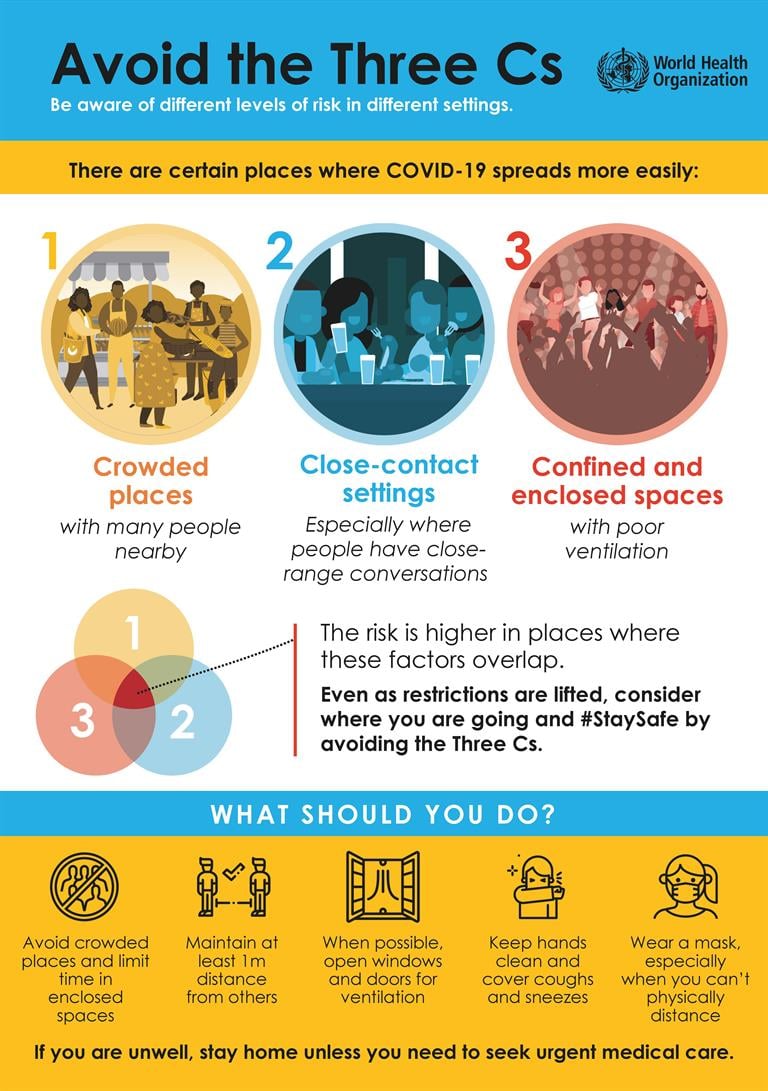
The “Three C’s” are a useful way to think about this. They describe settings where transmission of the COVID-19 virus spreads more easily:
- Crowded places;
- Close-contact settings, especially where people have conversations very near each other;
- Confined and enclosed spaces with poor ventilation.
The risk of COVID-19 spreading is especially high in places where these “3Cs” overlap.
In health facilities where people are receiving treatment for COVID-19, there is an increased risk of infection during medical procedures called aerosol generating procedures. These can produce very small droplets that can stay suspended in the air for longer periods of time and spread beyond conversational distances (typically 1 meter). This is why health workers performing these procedures or in settings where these procedures are performed should take specific airborne protection measures, including using appropriate personal protective equipment such as respirators. This is also why visitors are not permitted in areas where these procedures are being performed.
There are many things you can do to keep yourself and your loved ones safe from COVID-19. Know your risks to lower risks. Follow these basic precautions:
- Follow local guidance: Check to see what national, regional and local authorities are advising so you have the most relevant information for where you are.
- Keep your distance: Stay at least 1 metre away from others, even if they don’t appear to be sick, since people can have the virus without having symptoms.
- Wear a mask: Wear a well-fitting three-layer mask, especially when you can’t physically distance, or if you’re indoors. Clean your hands before putting on and taking off a mask.
- Read our Masks and COVID-19 Q&A and watch our videos on how to wear and make masks.
- Avoid crowded places, poorly ventilated, indoor locations and avoid prolonged contact with others. Spend more time outdoors than indoors.
- Ventilation is important: Open windows when indoors to increase the amount of outdoor air.
- Avoid touching surfaces, especially in public settings or health facilities, in case people infected with COVID-19 have touched them. Clean surfaces regularly with standard disinfectants.
- Frequently clean your hands with soap and water, or an alcohol-based hand rub. If you can, carry alcohol-based rub with you and use it often.
- Cover your coughs and sneezes with a bent elbow or tissue, throwing used tissues into a closed bin right away. Then wash your hands or use an alcohol-based hand rub.
- Get vaccinated: When it’s your turn, get vaccinated. Follow local guidance and recommendations about vaccination.
Read our public advice page for more information.
Read our Q&A about how to stay safe when attending and organizing small gatherings
Read our Q&A about ventilation and air conditioning and COVID-19