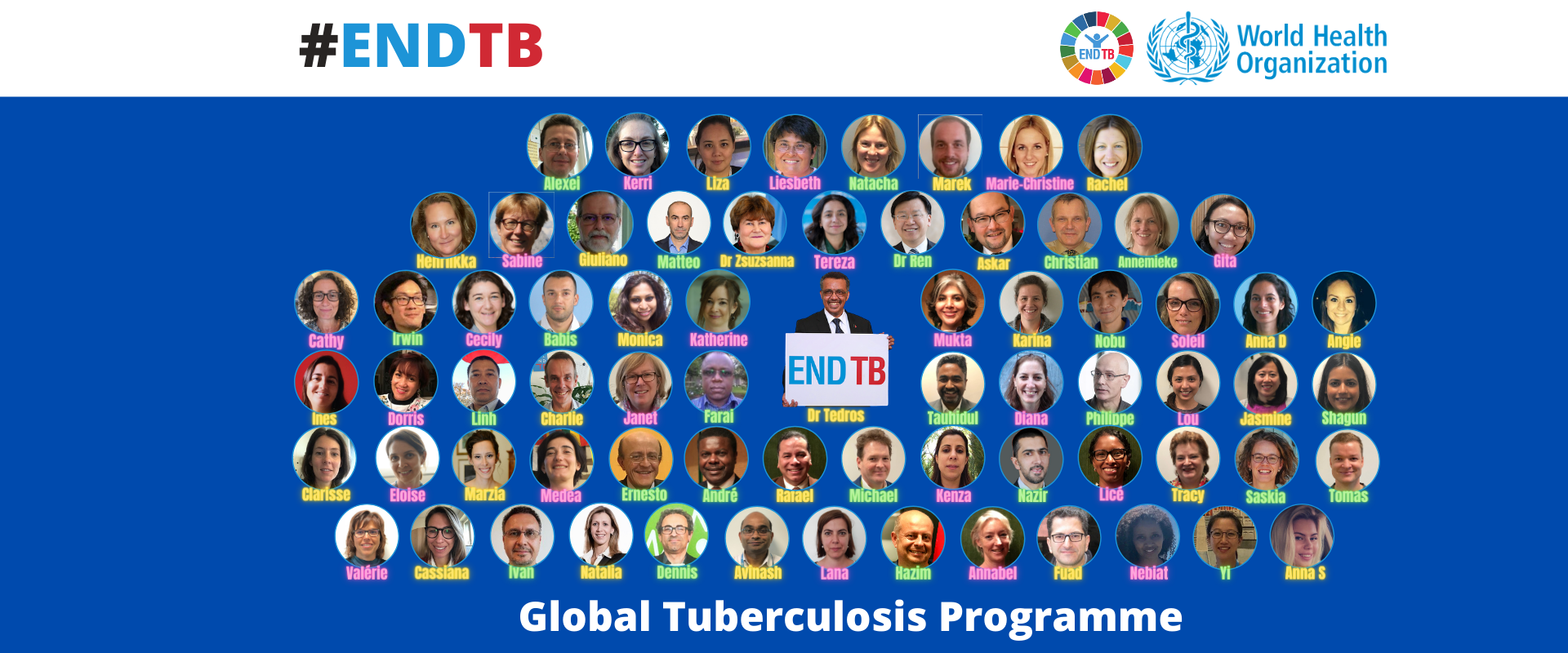
A Special Thank You!
Dear Friends, Colleagues and Partners,
2020 has been a challenging year for us all, but also one resonating with resilience and hope to overcome hardships. As the year comes to an end, I would like to take this opportunity to thank you all for your solidarity, commitment and dedicated work towards saving the lives of millions with tuberculosis (TB) and ensuring they are not left behind.
Over 63 million lives have been saved since the year 2000, and there has been overarching progress in driving down TB-related deaths and incidence. Yet as emphasized in the UN Secretary General’s Progress on TB developed with WHO support, and WHO’s Global TB Report: high-level commitments have galvanized global, regional and national progress towards ending TB, but urgent and more ambitious investments and actions are required to put the world on track to reach targets, especially in the context of the COVID-19 pandemic.
WHO and its leadership have been working intensively over the past months along with countries, health workers, communities, civil society and other partners to ensure continuity of essential TB services during the COVID-19 pandemic, while keeping the momentum in place towards achieving End TB commitments and reaching targets. WHO has continued leading the development of new policies and guidelines to ensure better outcomes for those affected, tackle drug-resistant TB, scale up access to TB preventive treatment and new diagnostic tools, backed by technical support to enable rapid implementation of new guidance in countries.
WHO is working closely with countries to support the uptake of the Multisectoral Accountability Framework, examples of high-level leadership on multisectoral accountability include Presidential or Head of State End TB initiatives and formalized mechanisms for the engagement and accountability of stakeholders in India, Indonesia, Pakistan, Philippines and Viet Nam as well as national campaigns to drive progress such as the “Race to End TB”. Worldwide in 2020, 86 countries are progressing with implementation of national multisectoral accountability mechanisms under high-level leadership, of which 62 included representatives of civil society and TB-affected communities.
Civil society engagement has been stronger than ever before through WHO’s Civil Society Task Force on TB, with their close collaboration in all areas of WHO’s work including policy development.
The Global Strategy for TB Research and Innovation was adopted by the World Health Assembly in August 2020. The strategy was developed under the leadership of WHO, through a consultative process with Member States including managers of national tuberculosis programmes and other officials from within and beyond ministries of health such as ministries of science and technology; the WHO Strategic and Technical Advisory Group for Tuberculosis (STAG-TB); the WHO Global TB Research Task Force; representatives of civil society and affected communities; research funding institutions; and other stakeholders in TB research and innovation. Four major areas for action are highlighted in the strategy: creating an enabling environment for TB research and innovation; increasing financial investments in TB research and innovation; promoting and improving approaches to data sharing; and promoting equitable access to the benefits of research and innovation. This global strategy will guide Member States and other relevant stakeholders in translating political commitments on TB research and innovation into concrete action backed by investment.
Since January 2020, when the novel coronavirus outbreak (2019-nCoV) was declared a Public Health Emergency of International Concern, the WHO Global TB Programme with Regional and Country Offices, in close collaboration with partners and civil society has been undertaking real-time monitoring of the COVID-19 pandemic including on TB notifications and service delivery, providing guidance and technical support to countries as well as supporting the procurement of drugs and diagnostics. WHO modelling and analysis on the impact of COVID-19 on TB mortality indicate that a 50% drop in the detection of TB cases over 3 months will lead to almost 400,000 more people dying due to TB in 2020 alone. WHO is working with countries, partners and civil society to ensure continuity of essential TB services and to learn lessons from the COVID-19 pandemic to strengthen preparedness and build-back stronger. In line with WHO guidance, countries have taken measures to mitigate the impact of COVID-19 on essential TB services, including by strengthening infection control, expanding use of digital technologies to provide remote advice and support, and providing home-based TB prevention and care.
All of the above efforts and actions are commendable, especially in the face of the COVID-19 crisis, and are contributing towards reaching the End TB targets including those of the WHO Director-General's Flagship Initiative "Find.Treat.All. #EndTB" with Stop TB Partnership and the Global Fund, as well as the triple billion targets of WHO's General Programme of Work. It shows how resilient we are as a community.
However, we just have two years to reach the targets and keep the promises made at the UN High Level Meeting on TB. To put the world on track to reach agreed targets by 2022 and beyond; and reduce the enormous human and societal toll caused by TB, we need to support Member States collectively to implement the 10 priority recommendations outlined in the 2020 UN Secretary General’s Progress Report on TB, and reach the targets outlined in WHO’s End TB Strategy. This will help step up the response.
We, at the WHO Global TB Programme, would like to thank all of you for your strong collaboration and partnership this year that has been critical for our work. We would like to salute all the health workers at the forefront of the fight to end TB and other diseases, those affected by TB including communities and survivors, countries and their national TB programmes, civil society, partners and donors for your tireless dedication and support to the fight to end TB.
We would like to thank core donors, contributors and partners to the work of WHO’s Global TB Programme during 2020: United States Government through the US Agency for International Development (USAID) & the US Center for Disease Control (US CDC), Netherlands, Russian Federation, the People's Republic of China, Luxembourg, Republic of Korea, Japan, The Global Fund to Fight AIDS, Tuberculosis and Malaria, Unitaid, KNCV Tuberculosis Foundation, Stop TB Partnership/UNOPS, European Respiratory Society, Bill & Melinda Gates Foundation, Bristol Myers and Squibb Foundation Inc. and London School of Hygiene and Tropical Medicine (LSHTM).
We express our gratitude to our senior leadership including to WHO Director-General Dr Tedros Adhanom Ghebreyesus, WHO Deputy Director-General Dr Zsuzsanna Jakab, WHO Assistant Director-General Dr Ren Minghui, Regional Directors and colleagues in WHO regional and country offices, for prioritizing efforts to end TB as part of efforts towards achieving Universal Health Coverage and ensuring the Right to Health for all, in the spirit of ONE WHO.
Dear friends, as we look to 2021 with new hope and optimism, we at WHO collectively recommit to keep the promises made to the millions affected by TB each year – despite any hardships, challenges or crises that come our way. We cannot stop till we reach every person, family and community impacted, and till we wipe out this top infectious killer once and for all.
Best wishes to you, your colleagues and loved ones, for a happy, healthy and fruitful 2021!
Director