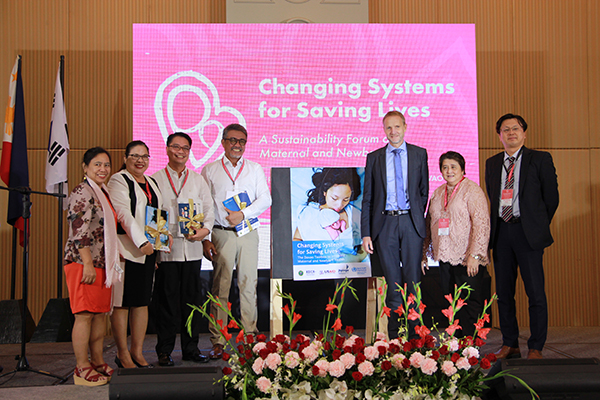
After three years of partnership between the Department of Health (DOH) Region XI, Korea International Cooperation Agency (KOICA) and the World Health Organization (WHO), the collaborative project closes with improved maternal and newborn health (MNH) outcomes in the Davao Region.
From baseline figures in 2014, maternal deaths have decreased by 53 percent and infant deaths have decreased by 32 percent in the whole Davao Region in 2017. Meanwhile, the maternal deaths reduced by 41 percent and infant deaths reduced by 12 percent in the 10 project sites from 2014 to 2017.
The 10 project sites are in Santa Maria, Malita and Don Marcelino (Davao Occidental); New Corella and Tagum City (Davao del Norte); Maco, Mabini and Pantukan (Compostela Valley); and Caraga and Manay (Davao Oriental).
“With the strong partnership that we have with KOICA and WHO, the innovations and strategies being implemented, and the commitment of our local government units to work hand in hand with our Department, we are hopeful that we can achieve our vision of zero infant and maternal mortality or Walang Nanay at Sanggol ang Mamatay dahil sa Panganganak,” stated Dr Anabelle P. Yumang, the Regional Director of DOH Regional Office XI.
“We are pleased that this project has made some strides towards the improvement of health service delivery in the country,” said KOICA Country Director SHIN Myung Seop. “We share the belief that lasting and sustainable change could be realized by strengthening systems and we will continue to work closely with our partners together to improve the quality of MNH services.”
The DOH-WHO-KOICA project, called Accelerating Convergence Efforts through Systems Strengthening for Maternal and Newborn Health (AcCESS for MNH), applied a health systems strengthening approach to help save the lives of mothers and their newborn babies by combining the three key result areas on (1) enhancing governance, (2) improving service delivery and (3) creating demand for maternal and newborn health.
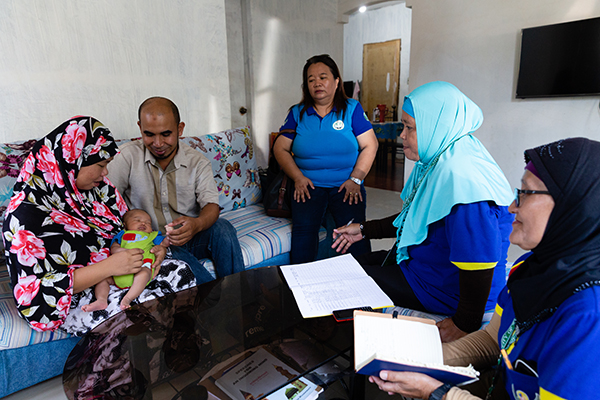
Enhancing governance entailed engaging with the local government and making them accountable through strengthened policy leadership and management mechanisms, financial management and information management. Improving service delivery focused on improving and equipping health facilities and honing the knowledge and skills of the health workers on obstetric and neonatal care. Creating demand involved the full commitment of a multi-sectoral health team called “Team D” to track and follow-up on all pregnant women in the community, and navigating them towards seeking MNH services in the health facilities.
“We have shown here in the Davao Region that a good health systems approach saves lives,” said WHO Representative in the Philippines Dr Gundo Weiler. “We hope that the gains will be sustained and expanded by our local partners to ensure that no mothers and babies will be left behind.”