
Surveillance system for Typhoon Pablo (international name Bophal) detected common illnesses for rapid and appropriate action. The Surveillance in Post Extreme Emergencies and Disasters (SPEED) is a mobile-based early warning system to detect common health conditions in an emergency. Immediately after the typhoon made landfall on 4 December, SPEED was activated by the Department of Health (DOH) and the entire health sector. The said typhoon affected 48 municipalities and 4 cities in Compostela Valley, Davao Oriental, Davao del Norte and Surigao del Sur.
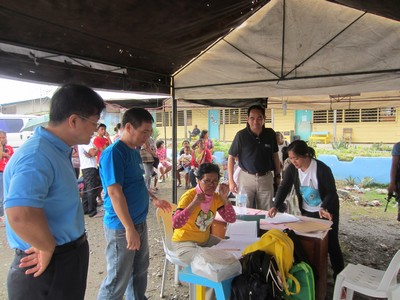
Dr Woo-Jin Lew, the Acting WHO Representative in the Philippines, visited one of the health posts set up after Typhoon Pablo rendered thousands of people homeless in Davao . Also in photo are: Dr Gerrie Medina and Dr Art Pesigan.
Recent SPEED reports showed that the most common consultations among typhoon survivors included: acute respiratory infections, wounds and bruises, hypertension, skin diseases and fever. Suspect measles cases and diarrhoea were also reported. As of 20
December, based on NDRRMC report, the total population affected is 701, 257 families in 352 cities and municipalities, 34 provinces in Regions 4B, 6,7,8,9,10,11 and CARAGA.
SPEED reports alerted the Regional Epidemiology Surveillance Unit
(RESU) of DOH Center for Health and Development (CHD) XI and the National Epidemiology Centre (NEC) who immediately deployed teams to conduct further epidemiologic investigation. Programme managers and implementers were also dispatched to conduct
measles immunization, vitamin A supplementation, health promotion and provide support to local health staff. SPEED alerts public health authorities to start interventions even before diseases reach alarming levels. Disrupted power sources and communication
in many areas are still the main challenges for effective SPEED reporting coverage.
The SPEED system was developed by the DOH through the support of the Australian Agency for International Development (AusAID), the United States Agency
for International Development (USAID) and the Government of Finland through the technical guidance of the World Health Organization (WHO). The SPEED system was developed after Tropical Storm Ondoy (Ketsana, 2009) in Luzon and further strengthened
following lessons learnt after Tropical Storm Sendong (Washi, 2011) in Northern Mindanao. It uses mobile phone technology to send reports on more than 20 disease syndromes and health events commonly seen during a health emergency. Information from
first line health workers and volunteers are sent to a central portal/ databank that can be immediately accessed by health authorities at different levels.
A strong health information system is crucial to an effective health emergency response
in order to detect trends in diseases and provision of health services. In addition to an effective information system, a well-functioning health system is essential to save lives and respond to the magnitude of people who need care. The DOH and its
local health offices are leading in heath sector response efforts. Strong coordination with and among international and local partners is vital.
“Health system response efforts have many essential components,” explained Dr
Woo-Jin Lew, acting WHO Representative in the Philippines. “Human resources and health services are constrained but the government and partners are looking at how best services can be made available. There are areas and barangays where access
to health care is still difficult due to damaged roads, bridges and lack of transportation.”
“It is alarming that many health facilities were completely or partially damaged,” Dr Lew continued. “Medicines, supplies,
records and equipment in these facilities were also destroyed. Vaccines need a cold chain system to remain effective. Patients suffering from chronic diseases such as tuberculosis, hypertension and diabetes mellitus also require continuous medicine
supply. We can prevent the outbreak of diseases through safe and sufficient water, proper nutrition, good hygiene and environmental sanitation.”