
Leishmaniases: Epidemiological Report of the Americas
Nº 5 - 2017, April
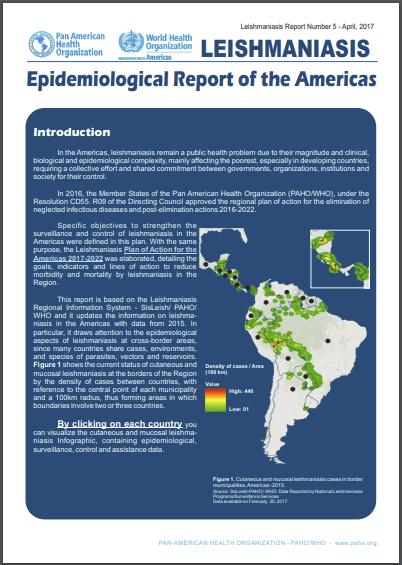
Overview
In the Americas, leishmaniasis remain a public health problem due to their magnitude and clinical, biological and epidemiological complexity, mainly affecting the poorest, especially in developing countries, requiring a collective effort and shared commitment between governments, organizations, institutions and society for their control.
In 2016, the Member States of the Pan American Health Organization (PAHO/WHO), under the Resolution CD55. R09 of the Directing Council approved the regional plan of action for the elimination of neglected infectious diseases and post-elimination actions 2016-2022.
Specific objectives to strengthen the surveillance and control of leishmaniasis in the Americas were defined in this plan. With the same purpose, the Leishmaniasis Plan of Action for the Americas 2017-2022 was elaborated, detailing the goals, indicators and lines of action to reduce morbidity and mortality by leishmaniasis in the Region.
This report is based on the Leishmaniasis Regional Information System - SisLeish/ PAHO/ WHO and it updates the information on leishmaniasis in the Americas with data from 2015. In particular, it draws attention to the epidemiological aspects of leishmaniasis at cross-border areas, since many countries share cases, environments, and species of parasites, vectors and reservoirs.