
Public Health Situation Analysis - Sudan Conflict and Complex Emergency
06 January 2026
Overview
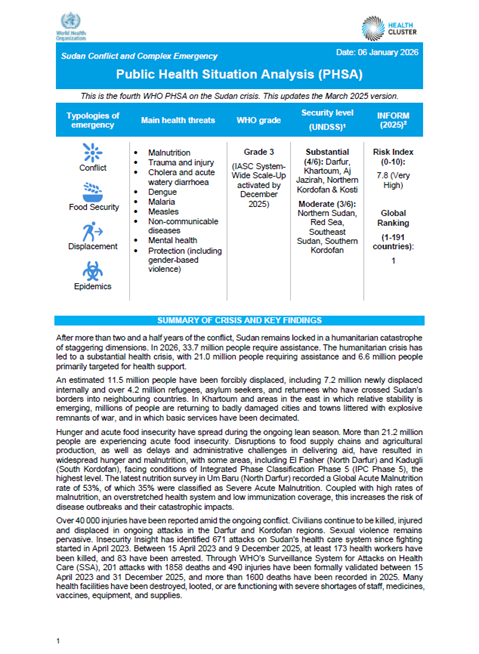
After more than two and a half years of the conflict, Sudan remains locked in a humanitarian catastrophe of staggering dimensions. In 2026, 33.7 million people require assistance. The humanitarian crisis has led to a substantial health crisis, with 21.0 million people requiring assistance and 6.6 million people primarily targeted for health support.
An estimated 11.5 million people have been forcibly displaced, including 7.2 million newly displaced internally and over 4.2 million refugees, asylum seekers, and returnees who have crossed Sudan’s borders into neighbouring countries. In Khartoum and areas in the east in which relative stability is emerging, millions of people are returning to badly damaged cities and towns littered with explosive remnants of war, and in which basic services have been decimated.
Hunger and acute food insecurity have spread during the ongoing lean season. More than 21.2 million people are experiencing acute food insecurity. Disruptions to food supply chains and agricultural production, as well as delays and administrative challenges in delivering aid, have resulted in widespread hunger and malnutrition, with some areas, including El Fasher (North Darfur) and Kadugli (South Kordofan), facing conditions of Integrated Phase Classification Phase 5 (IPC Phase 5), the highest level. The latest nutrition survey in Um Baru (North Darfur) recorded a Global Acute Malnutrition rate of 53%, of which 35% were classified as Severe Acute Malnutrition. Coupled with high rates of malnutrition, an overstretched health system and low immunization coverage, this increases the risk of disease outbreaks and their catastrophic impacts.
Over 40 000 injuries have been reported amid the ongoing conflict. Civilians continue to be killed, injured and displaced in ongoing attacks in the Darfur and Kordofan regions. Sexual violence remains pervasive. Insecurity Insight has identified 671 attacks on Sudan's health care system since fighting started in April 2023. Between 15 April 2023 and 9 December 2025, at least 173 health workers have been killed, and 83 have been arrested. Through WHO’s Surveillance System for Attacks on Health Care (SSA), 201 attacks with 1858 deaths and 490 injuries have been formally validated between 15 April 2023 and 31 December 2025, and more than 1600 deaths have been recorded in 2025. Many health facilities have been destroyed, looted, or are functioning with severe shortages of staff, medicines, vaccines, equipment, and supplies.
Multiple disease outbreaks are occurring simultaneously, including cholera, dengue, malaria, measles, hepatitis E, and diphtheria. WHO and its partners have revamped efforts to strengthen surveillance, rapid response capacity, and vaccination campaigns. However, resources remain stretched, both in terms of human capacity and funding. Sudan faces a disrupted health system, and insecurity, displacement, and limited access to health products, with challenges in basic infrastructure, continue to pose enormous challenges to delivering health care across the country. The siege of El Fasher for over 18 months with severe restrictions on movement, access to food, water, and medical care in El Fasher have resulted in civilians, including large numbers of children, experiencing repeated bombardment and deteriorating living conditions, which were compounded by the heavy rainfall and other climatic events, severely disrupting communication and connectivity. Following the capture of the city, massive displacements to nearby areas have led to pressures for the suboptimal resources to areas of displacement. El Fasher has since remained greatly cut off from humanitarian interventions- with conditions expected to have worsened with dire need for humanitarian access.