Hand hygiene
Implementation tools
To succeed in IPC and bring about safer, high quality health care practices, implementation at the point of care is critical. Looking to the future, development and maintenance of implementation plans to translate recommendations into practice must be a key focus for everyone. IPC tools and resources made available by WHO are associated with a multimodal implementation approach that integrates IPC best practices within an improved safety and organizational culture. This approach has been shown to succeed in making the change that people want to see in health care.
Key resources for implementation
Hand hygiene for all initiative: improving access and behaviour in health care facilities
The WHO and UNICEF-led Hand Hygiene for All Initiative aims at ensuring implementation for WHO's global recommendations on hand hygiene to prevent and...
A guide to the implementation of the WHO multimodal hand hygiene improvement strategy
WHO_IER_PSP_2009.02_chi.pdf (5.297Mb) WHO_IER_PSP_2009.02_per.pdf (1.857Mb)
This guide to local production of WHO-recommended handrub formulations is separated into two discrete but interrelated sections:Part A provides a practical...
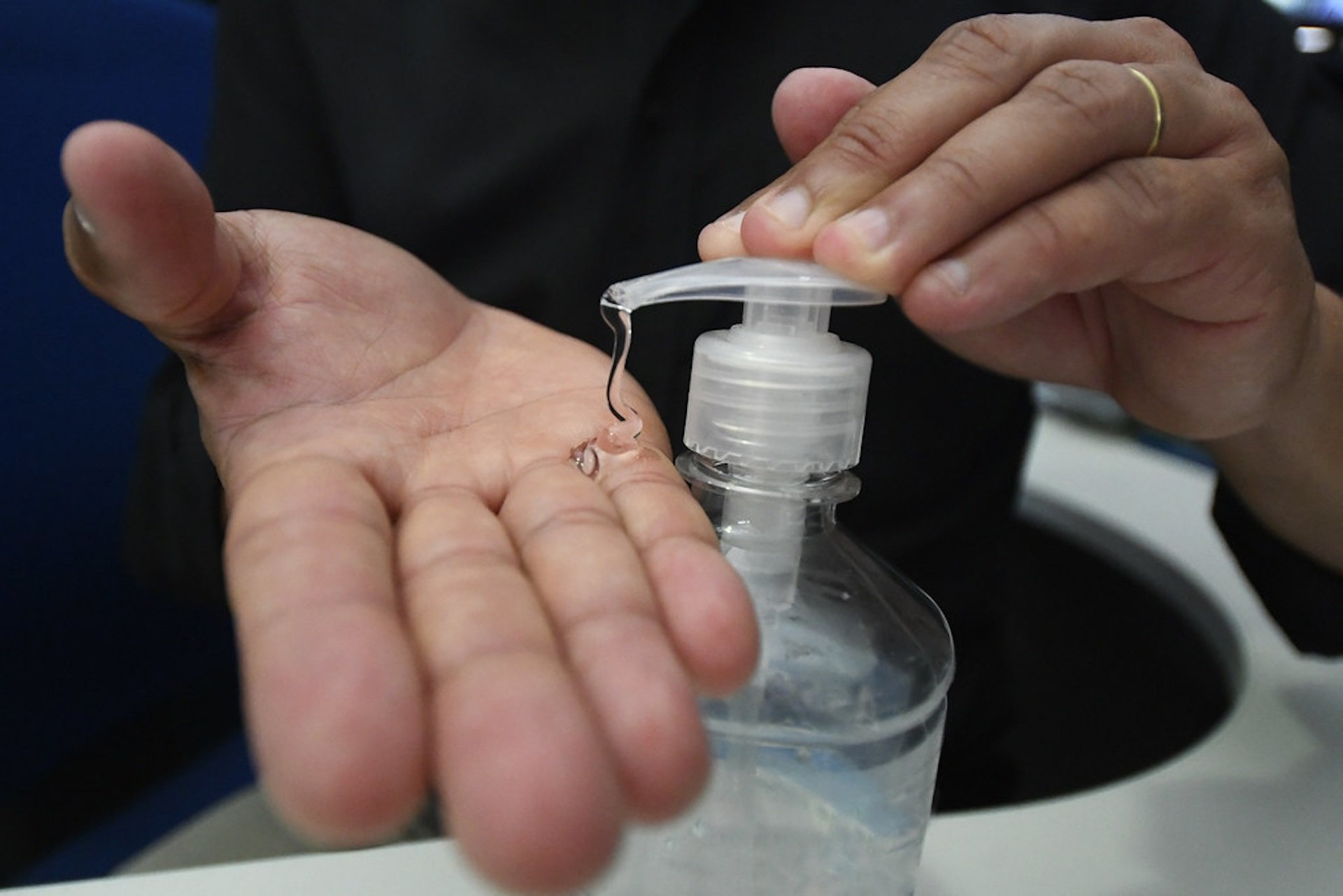
Alcohol-based handrub
Implementing alcohol-based handrub
To help determine the feasibility of implementing alcohol-based handrub at your health-care facility. This is an updated version of the tool (revised March 2010). There are some changes in the assumptions in section III as compared to previous versions. These are explained more clearly in the document.
Medical gloves are crucial for preventing infection when exposed to blood and body fluids, but they don't replace proper hand hygiene.
Tools for creating an institutional safety climate
The institutional safety climate refers to the environment and perceptions of patient safety issues at the health-care facility, in which hand hygiene improvement is a high priority.
The institutional safety climate will be a key priority for health-care facilities in advanced stages of hand hygiene improvement in order to maintain motivation and momentum for the excellent standards achieved. It is, however, important to consider the Institutional Safety Climate at all stages.
The following resources are available to help assist you in creating an institutional safety climate:
- Tips for patients to participate in hand hygiene improvement
- Tips for implementing a patient participation programme
- Information for patients and consumers - hand hygiene and antimicrobial resistance
- Template letter to advocate hand hygiene to managers (revised August 2009)
- Template letter to communicate hand hygiene initiatives to managers (revised August 2009)
- Guidance on engaging patients and patient organizations in hand hygiene initiatives
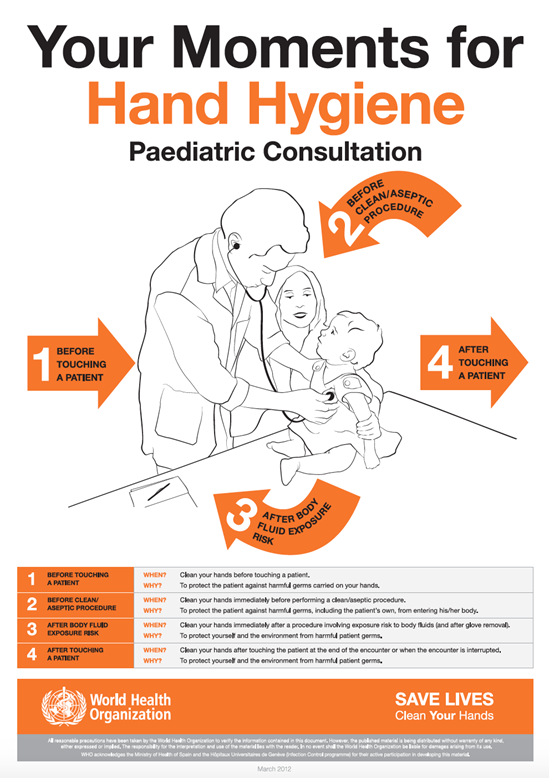
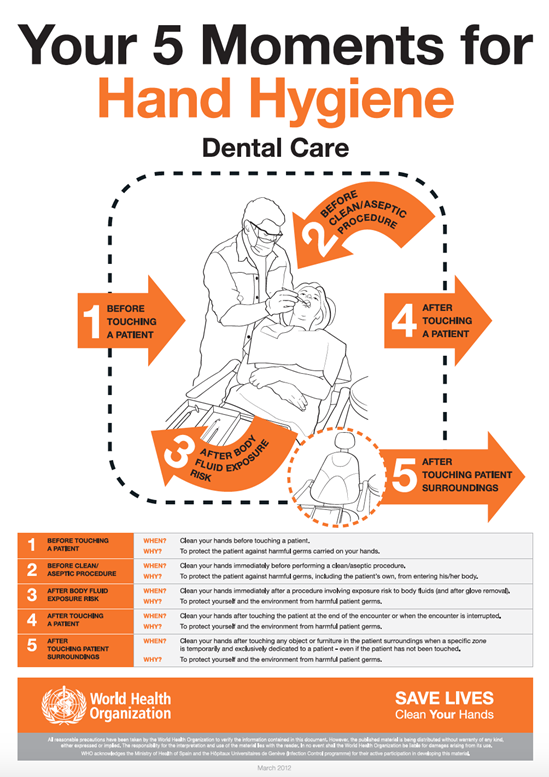
Five moments for hand hygiene - posters
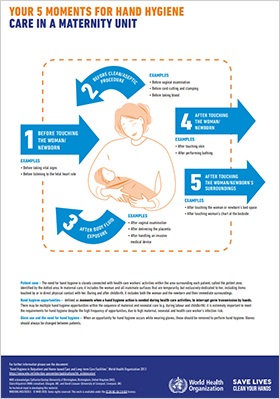
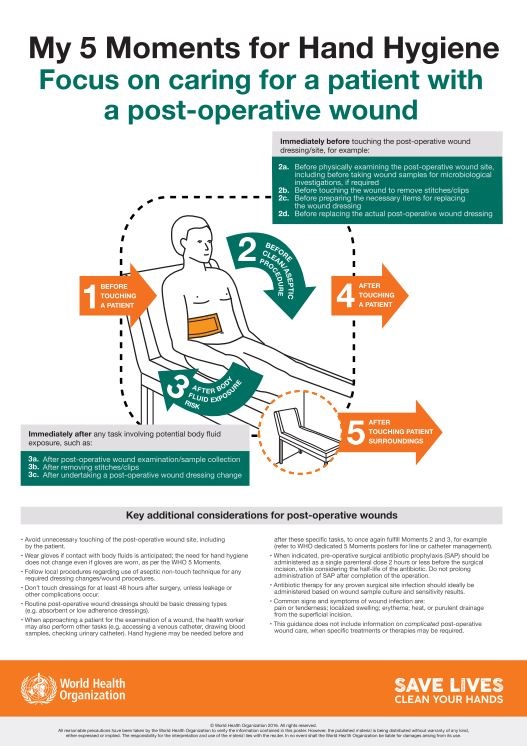
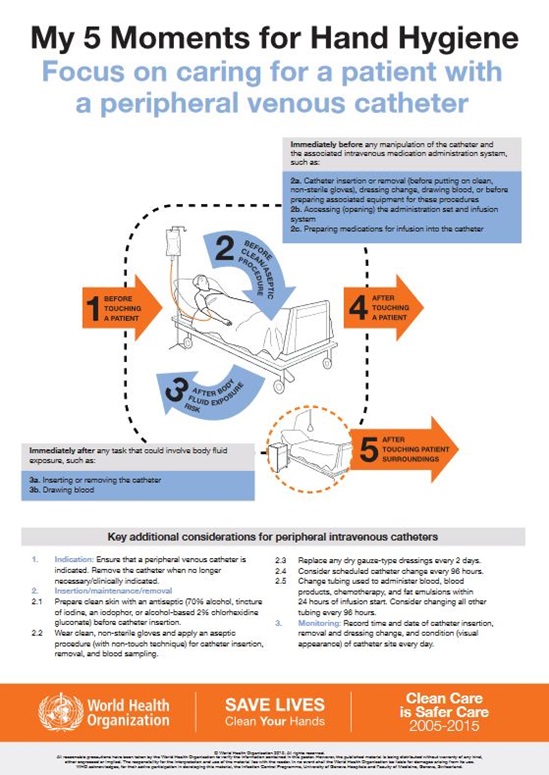
The My 5 Moments for Hand Hygiene approach defines the key moments when health-care workers should perform hand hygiene. This evidence-based, field-tested, user-centred approach is designed to be easy to learn, logical and applicable in a wide range of settings.
The posters are also available in French and Spanish. To access these other languages, click on the "read more" button of the resource of interest below.
Several country specific resources translated in different languages are also available here.

Five moments for hand hygiene Moment 2
It takes just 5 moments to change the world. Clean your hands, stop the spread of drug-resistant germs!Moment 2: Before clean/aseptic procedure
Five moments for hand hygiene Moment 3
It takes just 5 moments to change the world. Clean your hands, stop the spread of drug-resistant germs!Moment 3: After body fluid exposure risk

Five moments for hand hygiene Moment 5
It takes just 5 moments to change the world. Clean your hands, stop the spread of drug-resistant germs!Moment 5: After touching patient surroundings
Five moments for hand hygiene - One pagers