
/noncommunicable-diseases-rehabilitation-and-disability-(ncd)/office-of-the-director-ncd-(odn)/ncds-knowledge-action-portal.jpg?sfvrsn=d75056b8_4 "NCDs knowledge action portal")
Knowledge Action Portal on NCDs
Take a look behind the scenes of the Knowledge Action Portal (KAP).

Take a look behind the scenes of the Knowledge Action Portal (KAP).
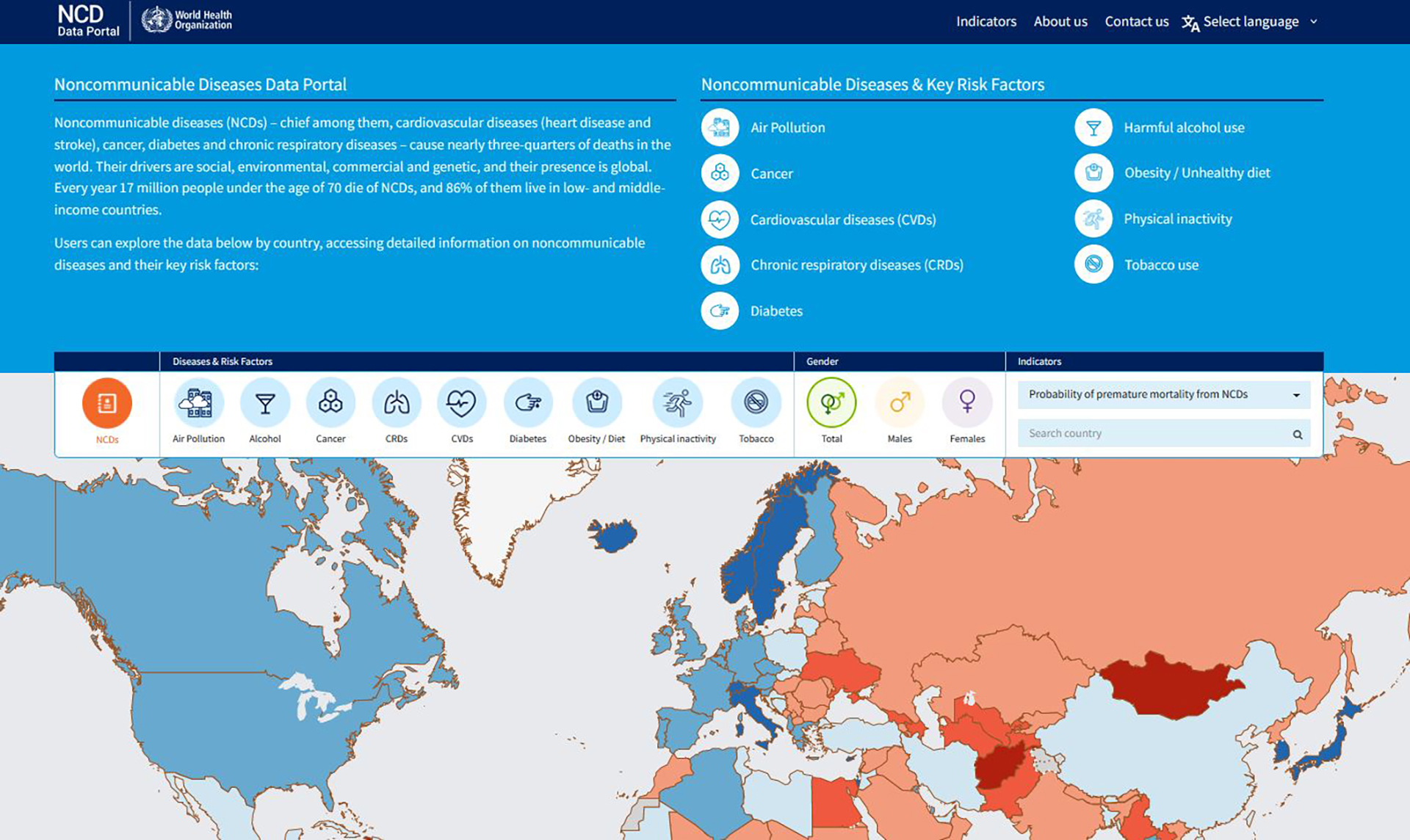
Explore the data by country
/noncommunicable-diseases-rehabilitation-and-disability-(ncd)/office-of-the-director-ncd-(odn)/on-the-road-to-2025-countdown-days.jpg?sfvrsn=7d7b21e4_79 "On the road to 2025 countdown days")
Preparatory process for the Fourth High-level Meeting of the UN General Assembly on the prevention and control of NCDs (HLM4)
/noncommunicable-diseases-rehabilitation-and-disability-(ncd)/office-of-the-director-ncd-(odn)/un-general-assembly-meeting-room.jpg?sfvrsn=b07fcc1d_7 "UN General Assembly meeting room")
for the Global action plan for the prevention and control of NCDs 2013–2030
Related health topics
Noncommunicable diseases
Cervical cancer develops in a woman's cervix (the entrance to the uterus from the vagina). Its primary cause is the infection with high-risk human papillomaviruses (HPV). Cervical cancer is caused by sexually acquired infection with certain types of human papillomavirus (HPV).
Technical links
Sensory functions, disability and rehabilitation
Risk factors
Other related health topics
This guidance supports countries in implementing human papillomavirus (HPV) DNA-based cervical cancer screening programmes in line with WHO recommendations...

The Global status report on cancer 2026: the future we choose together provides a comprehensive assessment of the global burden of cancer, progress in...
The fifth in a series, the World Health Organization's 2025 Noncommunicable Diseases (NCD) Progress Monitor provides a snapshot of country progress toward...
This document aims to set out the criteria for nucleic acid tests (NATs) to align with human papillomavirus (HPV) screening guidelines to detect cervical...
In 2022, cervical cancer was the fourth most commonly occurring cancer among women globally and also the fourth leading cause of cancer deaths among...
Key themes were raised by members of the Director-General’s Expert Group on cervical cancer elimination (CCEI) following technical updates on...
This document brings a new focus to the management of invasive disease in the comprehensive control and eventual elimination of cervical cancer. Aligned...
This publication, Improving data for decision-making: a toolkit for cervical cancer prevention and control programmes, expands the support provided...
Feature stories
Fact sheets
Articles
Engagement with the private sector
Noncommunicable diseases and COVID-19