
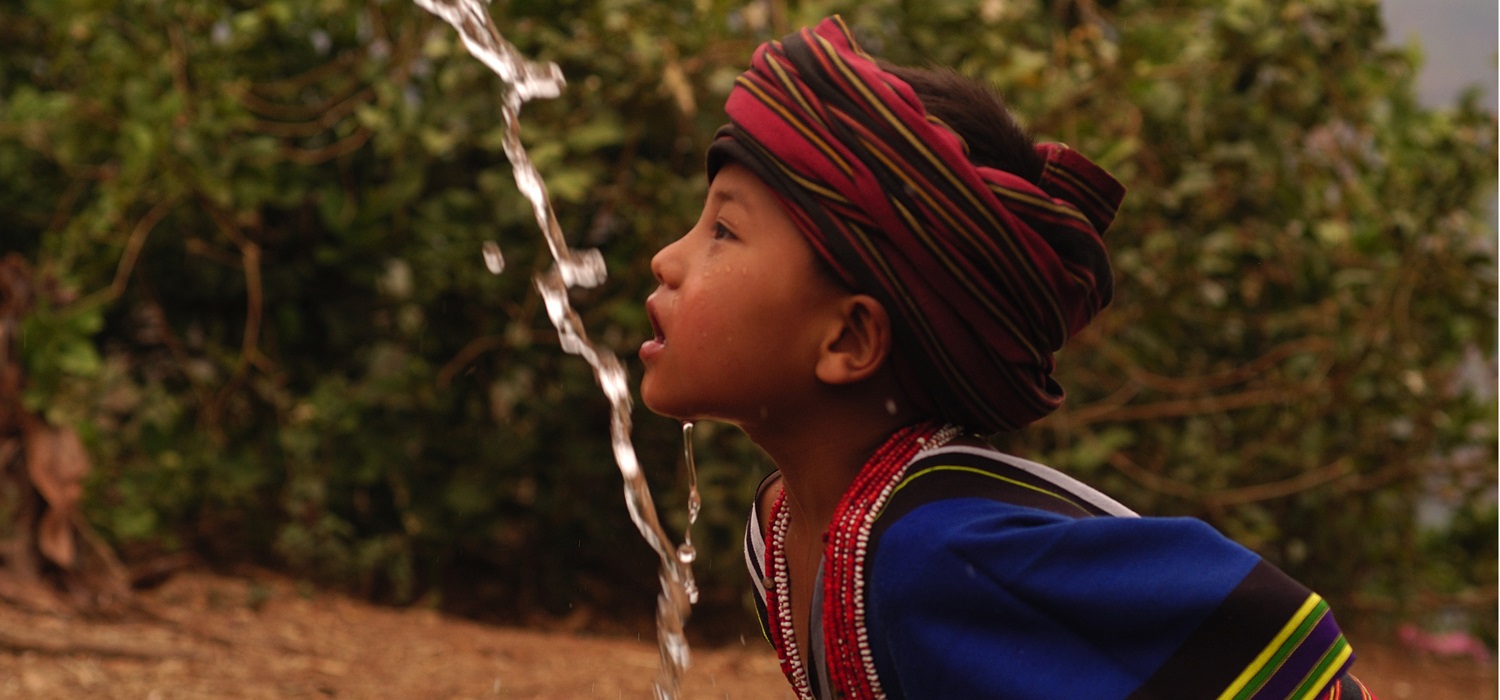
A child in Myanmar drinking from a tap
Water, sanitation and hygiene (WASH)
Safe drinking-water, sanitation and hygiene are crucial to human health and well-being. Safe WASH is not only a prerequisite to health, but contributes to livelihoods, school attendance and dignity and helps to create resilient communities living in healthy environments.
Drinking unsafe water impairs health through illnesses such as diarrhoea, and untreated excreta contaminates groundwaters and surface waters used for drinking-water, irrigation, bathing and household purposes.
Chemical contamination of water continues to pose a health burden, whether natural in origin such as arsenic and fluoride, or anthropogenic such as nitrate.
Safe and sufficient WASH plays a key role in preventing numerous NTDs such as trachoma, soil-transmitted helminths and schistosomiasis. Diarrhoeal deaths as a result of inadequate WASH were reduced by half during the Millennium Development Goal (MDG) period (1990–2015), with the significant progress on water and sanitation provision playing a key role.
Evidence suggests that improving service levels towards safely managed drinking-water or sanitation such as regulated piped water or connections to sewers with wastewater treatment can dramatically improve health by reducing diarrhoeal disease deaths.
Safe drinking-water, sanitation and hygiene (WASH) are crucial to human health and well-being. Safe WASH is not only a prerequisite to health, but contributes to livelihoods, school attendance and dignity and helps to create resilient communities living in healthy environments. Drinking unsafe water impairs health through illnesses such as diarrhoea, and untreated excreta contaminates groundwaters and surface waters used for drinking-water, irrigation, bathing and household purposes. This creates a heavy burden on communities. Chemical contamination of water continues to pose a health burden, whether natural in origin such as arsenic and fluoride, or anthropogenic such as nitrate. Safe and sufficient WASH plays a key role in preventing numerous neglected tropical diseases (NTDs) such as trachoma, soil-transmitted helminths and schistosomiasis.
However, poor WASH conditions still account for more than one million diarrhoeal deaths every year and constrain effective prevention and management of other diseases including malnutrition, NTDs and cholera.
Evidence suggests that improving service levels towards safely managed drinking-water or sanitation such as regulated piped water or connections to sewers with wastewater treatment can dramatically improve health by reducing diarrhoeal disease deaths.
WHO develops, updates and disseminates health-based guidance documents and best practice guides, norms and standards that support standard-setting and regulations at national level, particularly for drinking-water safety, effective surveillance approaches, recreational water quality, sanitation safety, safe wastewater use, WASH in health and educational facilities, and WASH monitoring.
WHO empowers countries through multi-sectoral technical cooperation, advice and capacity building to governments, practitioners and partners including on health and WASH sector capacities with respect to their public health oversight roles, national policies and regulatory frameworks, national systems for effective water quality and disease surveillance, including outbreak response, national systems for WASH monitoring, and national WASH target-setting.
WHO provides reliable and credible WASH data to inform policies and programmes including on WASH risk factors and burden of disease, the status of key output indicators for WASH, progress towards relevant WASH-related SDG targets, the enabling environment for WASH including WASH finance, and wastewater and SDG 6 interlinkages.
WHO coordinates with multi-sectoral partners, leads or engages with global and regional platforms, and advocates for WASH to influence political will and policy uptake of effective WASH strategies, increase focus on effective WASH regulations and policies, and expand and strengthen multi-sectoral collaboration at national level.
WHO promotes integration of WASH with other health programmes, for example disease programmes for cholera and NTDs, emergencies programmes, quality care and infection prevention control, especially through WASH in health care facilities, nutrition programmes and antimicrobial resistance programmes.





/environment-climate-change-and-health-(ech)/water-sanitation-hygiene-and-health-(wsh)/solid-waste-launch-webinar.tmb-549v.jpg?sfvrsn=e409f3df_2)
