Partner in global health
This content was last updated on 5 August 2021
The World Health Organization and the Kingdom of Saudi Arabia have a strong, long-standing strategic partnership that has spanned over 6 decades. This multi-faceted and innovative partnership includes collaboration on capacity building initiatives, technical
collaboration, advocacy and resource mobilization for global health projects and programmes. As a key WHO partner, the Kingdom of Saudi Arabia has a proven track record in advocating for life-saving global health initiatives and works with the Organization
to reach their common goal to achieve the Sustainable Development Goals (SDGs).
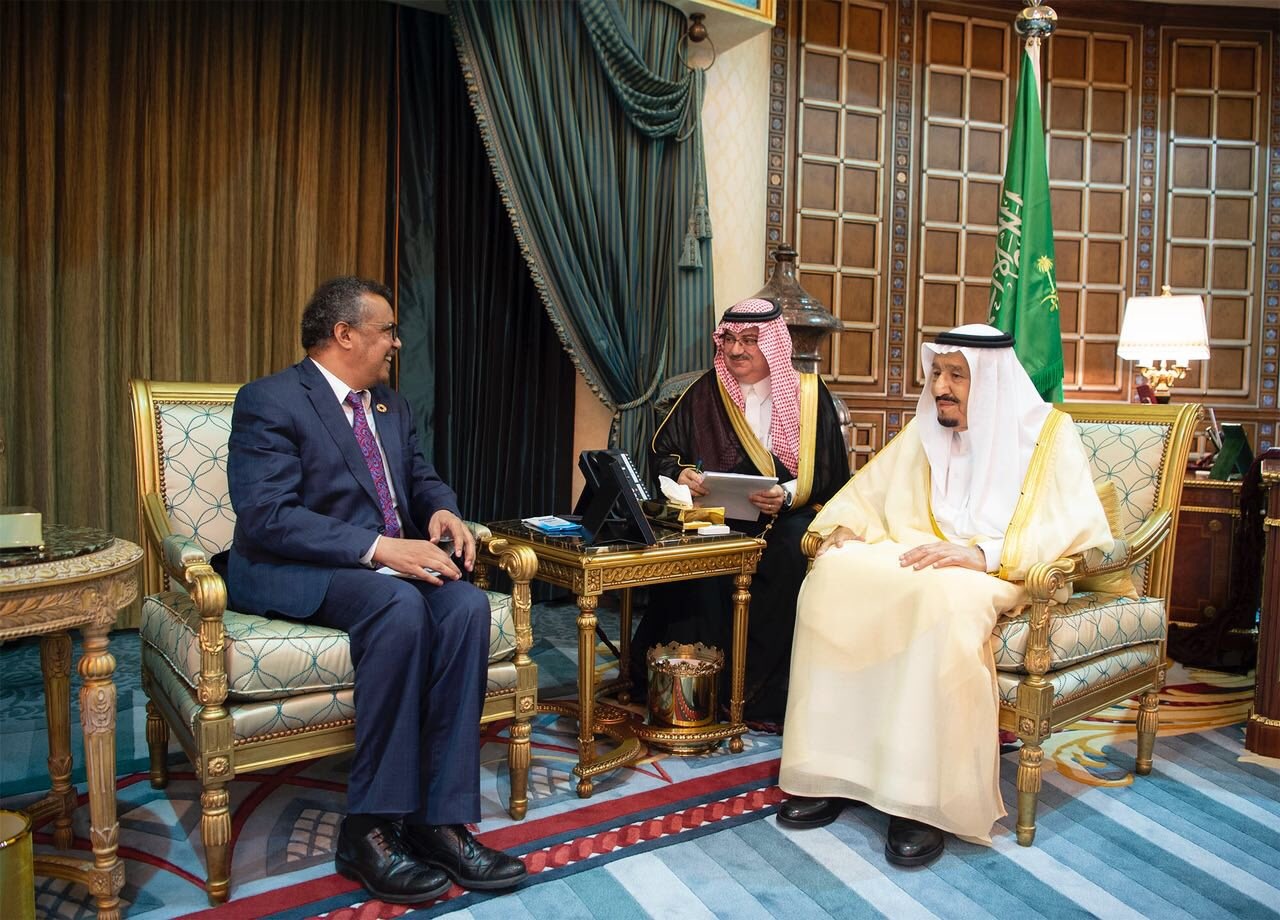
Dr Tedros met with His Majesty King Salman to discuss WHO-KSA cooperation and its important contributions to global health through support to polio eradication & emergencies
Since 2015, Saudi Arabia has consistently supported WHO and contributed over US$ 385 million to global health initiatives and emergency-related operations in various countries including Bangladesh, Iraq, Somalia, Syria and Yemen, among others. Moreover,
the Kingdom has been among WHO’s Top 20 donors for three consecutive years from 2018 – 2020, and ranked 6th among WHO’s voluntary contribution donors in 2020.
The level of funding from Kingdom of Saudi Arabia is increasing, with a focus on emergencies.
More about the support of the Kingdom of Saudi Arabia to WHO is available in the programme budget portal.
The Kingdom of Saudi Arabia is home to the annual Hajj pilgrimage performed by millions of Muslims from around the world; it presents a major public health priority for both the Kingdom and the international community. Over the years, Saudi Arabia has put in place many healthcare services for pilgrims to keep the Hajj season free from infectious and epidemic diseases, and the Kingdom and WHO have forged a strategic partnership on the development of health measures for the Pilgrimage.
WHO Representative, Dr Ibrahim El Ziq and WHO team coordinating with the Ministry of Health in preparation for the Hajj season
The Kingdom’s leadership of polio eradication efforts through the Organization of Islamic Cooperation (OIC) and the Islamic Development Bank has resulted in 55 of the 57 OIC Member States becoming polio-free. The Kingdom has addressed misconceptions about polio vaccines through Fatwas issued by the International Islamic Fiqh Academy (IIFA) in Jeddah which have significantly increased community trust and acceptance of vaccinations in all Muslim communities. Furthermore, polio vaccination requirements for all Hajj and Umrah pilgrims from polio priority countries have been enforced, thereby preventing polio outbreaks.
The Kingdom has also provided nearly US$ 40 million, primarily through the Saudi Fund for Development, to polio eradication efforts. And further to the 2020 "Call to Action", the Kingdom committed US$ 10 million for polio and measles outbreaks resulting from the halting of immunization activities due to the COVID-19 pandemic. These funds have allowed for the procurement and distribution of millions of doses of oral polio vaccine to protect tens of millions of children in the poorest countries of Africa and the Middle East (e.g. Chad, Ethiopia, Côte d'Ivoire, Kenya, Mali, Niger, Somalia, Sudan and Yemen), as well as in Afghanistan and Pakistan.
Afghanistan and Pakistan are the only two countries in the world that have not seen the interruption of wild poliovirus transmission. The GPEI looks forward to strong continued collaboration with the Kingdom until the world is certified polio-free.
Thank you, Kingdom of #SaudiArabia, for your additional contribution of $90 million to @WHO & for helping us respond to humanitarian risks caused by the #COVID19 pandemic & strengthen our support to countries with fragile health systems. Together!https://t.co/Y7qRrq7vHd
— Tedros Adhanom Ghebreyesus (@DrTedros) October 2, 2020
In 2020, as Saudi Arabia assumed the Presidency of the G20, the Custodian of the Two Holy Mosques King Salman Bin Abdulaziz Al Saud chaired the extraordinary G20 Leaders meeting where Saudi Arabia pledged US$ 500 Million in support of the Global Response to COVID-19. Through the G20 platform the Kingdom of Saudi Arabia also advocated for global solidarity and cooperation in combating the pandemic.
Over US$ 90 million was allocated to WHO in support of the implementation of the COVID-19 Strategic Preparedness and Response Plan (SPRP) as well as other key WHO programmes and activities including health in emergencies.
Strengthening the Sadar District Hospital in Cox's Bazar
In August 2017, violence in Rakhine State, Myanmar forced more than 646,000 Rohingya (Forcibly Displaced Myanmar Nationals, FDMN) across the border into Cox’s Bazar, Bangladesh, joining some 300,000 that fled in earlier waves of displacement. Pre-existing settlements and camps have expanded with the new influx, while new spontaneous settlements have also formed and are quickly growing. Significant numbers of new arrivals are also being absorbed into the local host community.
A combination of overcrowded living conditions, poor hygiene and low immunization coverage has left the FDMN population at risk for a wide range of infectious diseases, including Cholera, Measles, Rubella, and Diphtheria.
WHO and the King Salman Center for Humanitarian Relief collaborated on the renovation of Sadar hospital — the main provider of secondary health care and is the referral hospital in the Sadar district — to enhance health care delivery for the Rohingya population.
This collaboration between WHO and KSRelief has drastically improved conditions of the care facility and health services delivery to patients.
Since its emergence in 2012 in the Kingdom of Saudi Arabia and Jordan, MERS-COV has continued to infect humans mainly in the Arabian Peninsula, through direct or indirect contact with dromedaries. The Middle East Respiratory Syndrome Coronavirus (MERS-COV) is widespread in dromedary camels (Camelus Dromedaries; dromedaries) in the Middle East, large parts of Africa and likely in South Asia, though surveillance in animal species in south Asia is limited to date. The epidemic pattern of MERS has not changed since the virus's emergence in humans. Over 1950 laboratory confirmed cases and at least 693 deaths have been reported to WHO. Transmission has been amplified in health care settings across the Middle East resulting in small to large outbreaks in hospitals.
The Kingdom of Saudi Arabia supported the following actions to rapidly detect and contain the spread of MERS:
WHO praised KSA Ministry of Health for their response in controlling MERS Coronavirus
As part of their joint #malaria response in #Yemen, @KSRelief_EN & @WHO have supported the Ministry of Public Health&Population in implementing an 8-day Indoor residual spray campaign in 5 districts of Hadramout, Shabwah & Al-Mahra gov. to spray 9K households & protect 68K ppl. pic.twitter.com/brStuwr7Rd
— WHO Yemen (@WHOYemen) April 2, 2021
In 2020, WHO and the King Salman Humanitarian Aid and Relief Centre (KSRelief) signed a joint cooperation agreement for US$ 10.5 million further bolstering malaria prevention and control efforts across Yemen. Yemen accounts for 17% of the regional malaria cases. A total of 18.2 million people are at risk of malaria with WHO estimating the number of malaria cases at 842,226 cases.
The collaboration focusses on building response capacities in the areas of clinical case management, particularly on training health care providers to effectively manage and treat cases, and on vector control to stop the spread of the disease in communities in Yemen. Preparedness efforts include surveillance strengthening and the establishment of 7 febrile treatment centres in Aden, Lahj, Taizz, Al Hudaydah, Hajjah, Shabwa and Hadhramout, as well as training 1000 health workers to improve malaria and dengue preparedness and response.
The generous support of the Kingdom of Saudi Arabia to an important yet historically underfunded programme has made it possible for WHO to protect 1.6 million people through indoor residual spraying, and 4 million people against dengue through space fogging, source reduction and risk communication.
The Kingdom of Saudi Arabia is supporting WHO to accelerate sustainable implementation of national action plans on antimicrobial resistance (AMR) in low- and middle-income countries (LMICs). The collaboration is focused on strengthening WHO’s technical capacity to support countries implementing the human health sector aspects of the AMR response; enhancing the generation and use of data for policy, legislation, and programme activities; and galvanizing national and global multisectoral political commitment for country action and implementation.
AMR threatens a century of progress in health and the achievement of many of the Sustainable Development Goals. This has prompted WHO to spearhead the global response to AMR in the human health sector and to coordinate the global One Health response. With support from KSA, WHO will scale up support to LMICs across technical areas including multisectoral governance, awareness raising, laboratory capacity strengthening, surveillance of AMR and antimicrobial use, infection prevention and control (IPC), antimicrobial stewardship, and monitoring and evaluation.
Thank you King Salman Humanitarian Aid and Relief Center @KSRelief for the generous support and partnership in establishing a provincial- wide infection and prevention control program in Sendh, #Pakistan
— WHO EMRO (@WHOEMRO) April 6, 2021
📹Watch Regional Director’s video message pic.twitter.com/vbFRLcjyeD
The WHO Division of Data, Analytics and Delivery for Impact (DDI) was created as part of WHO's transformation agenda to foster a relentless focus on results, deliver on the health-related Sustainable Development Goals (SDGs) and meet the Triple Billion targets, backed by the highest standards of health data.
The generous support from the Kingdom of Saudi Arabia, along with other partners, has been catalytic in making WHO a modern-data-driven Organization at the cutting-edge of digital technology and innovation. The design and development of the World Health Data Hub (WHDH) is an interactive digital destination that serves as a trusted source of global health data for everyone, everywhere.
Support from the Kingdom of Saudi Arabia has contributed to data-driven decision making, including an open access Triple Billion Dashboard, tracking country progress towards the Triple Billion targets and SDGs.
Other strategic initiatives supported by the partnership include technical cooperation & exchange and the implementation of country-focused Delivery Stocktakes. The new Delivery for Impact implementation toolkit and peer-to-peer delivery network, support countries to build their data analytic capacities through knowledge exchange, digital tools and sharing best practices from countries that can be scaled with speed.
Over the years the enhanced partnership between WHO and Saudi Arabia has evolved to include joint technical collaborations with a wide network of locally based institutions and ministries. WHO collaborating centres in Saudi Arabia work towards achieving joint training and educational programmes, providing and distributing scientific data and information in addition to supporting and conducting research initiatives.
Currently there are five active collaborating centres in Saudi Arabia:
Health Affairs, Ministry of National Guard:
WHO Collaborating Centre for Child maltreatment Research and Planning
Saudi Food and Drug Authority:
WHO Collaborating Centre for medical Devices Regulation
Saudi Center for Disease Prevention and Control (SCDC)
WHO Collaborating Centre for Middle East Respiratory Syndrome (MERS)
King Abdulaziz Medical City Hospital:
WHO Collaborating Centre for Infection Prevention and Control and Anti-microbial Resistance
WHO Collaborating Centre on patient safety policies and strategies
WHO Collaborating Centre for Mass Gatherings Medicine
Dr Tedros Adhanom Ghebreyesus, Director-General, World Health Organization and SFA President, HRH Prince Khaled bin Alwaleed bin Talal Al Saud, during Walk the Talk initiative
WHO and the Saudi Sports for All Federation (SFA) have been strategic partners for several years, joining forces through various advocacy and awareness initiatives including the virtual Walk the Talk Health for All Challenge marking the opening of the 73rd World Health Assembly, and the New York City Walk the Talk in the fall of 2019 staged on the sidelines of the United Nations General Assembly.
In 2020, WHO and the Saudi Sports for All Federation (SFA) signed a collaborative agreement that addresses several strategic areas. The partnership includes an information exchange and technical collaboration that will enable WHO to provide technical assistance on the Federation’s strategy, aligning it with the global action plan of physical activity.
Special Recognition Award
In 2019, WHO recognized the accomplishments of Saudi Arabia in the area of tobacco control during the 72nd session of the World Health Assembly in Geneva. WHO Director-General Dr Tedros Adhanom Ghebreyesus presented the Director-General's Special Recognition Award to Dr Tawfiq Al Rabiah, Saudi Arabia's Minister of Health in recognition of the initiatives to control the use of tobacco in the country. Saudi Arabia was among the first countries to ratify WHOs Framework Convention on Tobacco Control to reduce smoking rates.
WHO Director-General Dr Tedros Adhanom Ghebreyesus presented the Director-General's Special Recognition Award to Dr Tawfiq Al Rabiah, Saudi Arabia's Minister of Health in recognition of the initiatives to control the use of tobacco in the country.
Videos & more from Social Media
With support from @KSRelief, @WHO is strengthening Sadar Hospital in #Cox's Bazar #Bangaldesh. 50 new beds & a generator have been added for uninterrupted medical services for 1.3 million #Rohingya refugees & their host community at risk of diseases in the coming rainy season. pic.twitter.com/kWDit84ccz
— WHO South-East Asia (@WHOSEARO) April 4, 2019
Special thanks to Saudi Arabia who airlifted critical @WHO #COVID19 supplies to #Yemen, including personal protective items for health workers & lab screening tests for Aden & Sana’a. The shipment also incl. trauma meds & supplies to support the ongoing response to the crisis. pic.twitter.com/g9zzorMAkv
— WHO EMRO (@WHOEMRO) March 23, 2020
We support the Kingdom of #SaudiArabia's decision to proceed with this year's #Hajj with a limited number of pilgrims of different nationalities living within 🇸🇦. This is another example of the hard choices that all countries must make to put health first. https://t.co/uLZMeGiCQQ
— Tedros Adhanom Ghebreyesus (@DrTedros) June 24, 2020
Thank you @KingSalman for your continuous support to the global #COVID19 response. @WHO strongly welcomes your leadership & solidarity among the @g20org. We are grateful for @KSRelief_EN's additional contribution of $10M to boost fragile health systems & stop the #coronavirus.
— Tedros Adhanom Ghebreyesus (@DrTedros) March 30, 2020
Today during the #RIHF, @WHO signed an agreement to help #EndMalaria in Yemen. Thank you Dr Abdullah Al Rabeeah, the Supervisor General of @Ksrelief, for Saudi Arabia's significant support. pic.twitter.com/YZrE4x4k6P
— Tedros Adhanom Ghebreyesus (@DrTedros) March 1, 2020