

Epidemic Intelligence from Open Sources
ZERO IMPACT FROM HEALTH THREATS
About EIOS
Epidemic Intelligence from Open Sources (EIOS) is the world’s leading initiative for open-source intelligence for public health decision-making. It is led by the WHO as part of its constitutional mandate as the directing and coordinating authority on international health work. EIOS is built on three pillars: a growing global community of practice, a range of multi-disciplinary collaborators and an evolving fit-for-purpose system. The system builds on a long-standing collaboration between WHO and the Joint Research Centre (JRC) of the European Commission (EC).
The global community, including Member States, international and regional organisations, expert networks, research institutes and other collaborators, is at the heart of the initiative. By the end of 2025, 120 countries and 30 organizations and networks were leveraging the EIOS system.



The initiative

In an increasingly connected world, threats to public health have the potential to quickly spread from local to national, regional and international levels, affecting global health security faster than ever before. The EIOS initiative aims to mitigate and, ideally, prevent public health emergencies by connecting experts around the world and providing them with the best possible solutions to detect, contextualise, analyse, assess and share information for quick, evidence-based action. As such, the EIOS initiative is by and for experts across national and international organisations, networks and government entities engaged in emergency preparedness and response.
The EIOS Strategy 2024–2026 was developed to support the continued expansion and sustainability of the initiative. It sets out a coordinated approach to strengthening Public Health Intelligence (PHI), focusing on enhancing the EIOS system, deepening engagement with the global Community of Practice, and connecting EIOS more closely with broader PHI efforts. The strategy envisions the EIOS initiative as a core part of how PHI is generated and applied, empowering decision-makers to act earlier and more effectively to reduce the impact of health threats worldwide.
The WHO Pandemic Hub

Since January 2022, the lead of the EIOS initiative is hosted within the new WHO Hub for Pandemic and Epidemic Intelligence. As one of the Hub’s flagship initiatives, EIOS supports its overall mission to facilitate the global collaboration of partners from multiple sectors, supporting countries and other stakeholders to address future pandemic and epidemic risks with better access to data, better analytical capacities, and better tools and insights for decision-making. With support from the Government of the Federal Republic of Germany, the WHO Pandemic Hub was established in September 2021 in Berlin, in response to the COVID-19 pandemic, which demonstrated weaknesses around the world in how countries detect, monitor and manage public health threats.
Developing solutions

The Pandemic Hub News Map is one example
of an application that has been developed with colleagues at the JRC to
visualise information coming through the EIOS system. The News Map displays the
headlines and snippets of the ten most recent articles the system has
identified as being related to a number of selected
as well as trending health topics in their original languages.
EIOS Global Technical Meeting All →
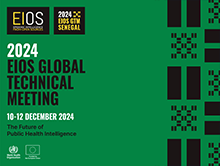
The EIOS Global Technical Meeting, or “GTM” in short, is the key event for the EIOS community. In the spirit of the initiative, understanding itself as a global collaborative of multi-disciplinary experts, the meeting aims to regularly bring these experts together to further strengthen existing networks, build new alliances as well as to discuss topical challenges, solutions and innovations in the field of PHI.


Newsletters
All →
EIOS Newsletter May 2024
The May 2024 edition presents updates on EIOS implementation across all six WHO Regions, and dives into the concept of Collaborative Surveillance. It also...
EIOS Newsletter January 2024
In keeping with our cherished tradition, the start of the year invites a moment of reflection on our journey, revisiting milestones, and celebrating collective...

EIOS Newsletter October 2023
The final edition of 2023, the October Newsletter, highlights the new PHI Training Working Group and recaps the most recent EIOS Training of Trainers workshop...
EIOS Newsletter July 2023
The July edition provides updates on EIOS implementation from WHO Regional Offices and two of our collaborators (US CDC and WOAH) that took place in the...
Publications
All →Publications included in this section showcase articles describing practical use cases of the EIOS initiative or in which the EIOS system is analysed, evaluated, or compared to other PHI systems. The EIOS Core Team makes no claims or guarantees about the completeness, accuracy, content or quality of information contained.
Epidemic Intelligence from Open Sources (EIOS) Strategy 2024—2026
The EIOS Strategy 2024–2026 outlines the World Health Organization’s (WHO) coordinated approach to strengthening public health intelligence...
Impact of using the Epidemic Intelligence from Open Sources (EIOS) system for early detection of public...
Epidemic intelligence, which integrates event- and indicator-based surveillance, requires systematic, organized collection, analysis and interpretation...
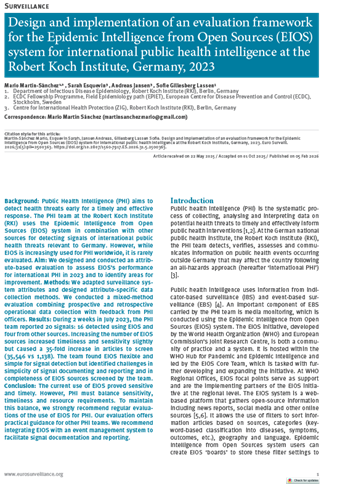
Public Health Intelligence (PHI) aims to detect health threats early for a timely and effective response. The PHI team at the Robert Koch Institute (RKI)...
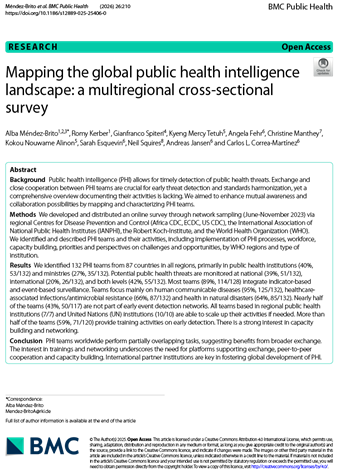
Mapping the global public health intelligence landscape: a multiregional cross-sectional survey
Public health intelligence (PHI) allows for timely detection of public health threats. Exchange and close cooperation between PHI teams are crucial for...