

Technology
The EIOS system
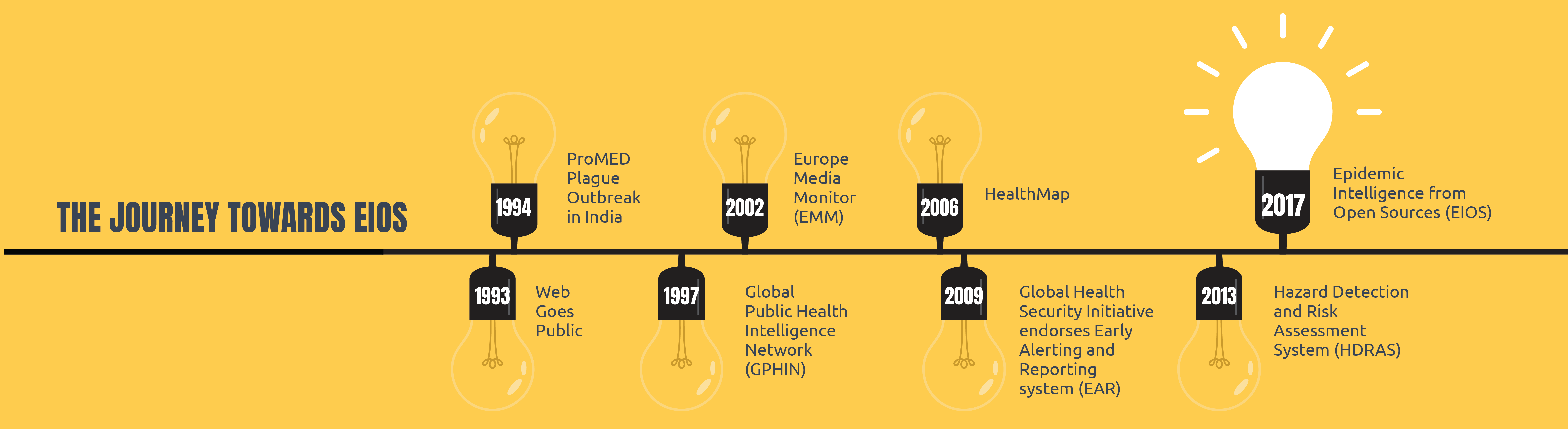
The EIOS system is a fit-for purpose web-based platform that augments and accelerates national, regional, and global Public Health Intelligence (PHI) activities. The EIOS system was built through a long-standing collaboration between the WHO and the Joint Research Centre (JRC) of the European Commission and augmented by an increasing number of partners. EIOS is an evolving system designed to meet the dynamic challenges of global health security, by globally supporting experts in PHI.
In 2025, the release of the EIOS system version 2 (EIOS v.2) marks a strategic milestone in the platform’s modernization, introducing a fully re-architected backend to better support scalability, integration, and evolving user needs. This transition not only brings enhanced functionality and new AI-powered features, but also establishes a more agile, iterative development model that will accelerate innovation and applied research. Find out more about EIOS system v2 and other technology collaborations here.
How does the EIOS system work?
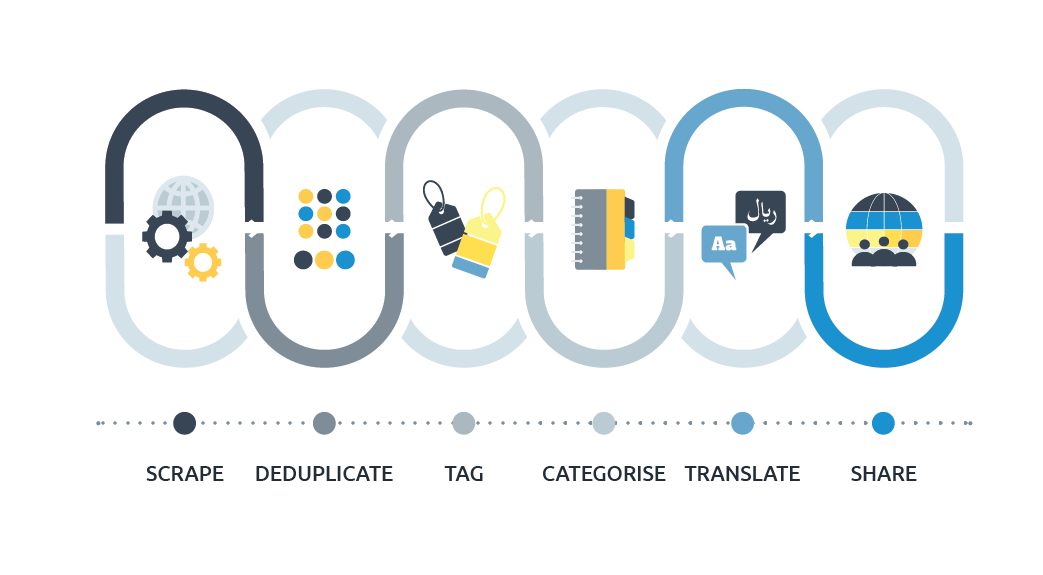
Each day, the EIOS system fetches and processes hundreds of thousands of articles in near real time from a broad range of sources, including traditional media, social media, government websites, blogs, expert groups, and news aggregators. This vast data flow is automatically analyzed through a set of modules developed by the JRC and multiple partners. Automated analysis “behind the scenes” is comprised of text mining, natural language processing (NLP), named entity recognition and machine learning algorithms, to sort and categorize the ingested articles by topics, locations, languages, and other contextual indices. These refined datasets are then presented within the EIOS portal, allowing users to slice-and-dice the information according to their needs in supporting an all-hazards One-Health approach, and enables collaboration and information sharing both within and across organizations.
Scalability, high-volume processing, and modularity
In order to handle surges in data flow, as well as in usage, the EIOS system must be highly scalable. High-level events, as experienced at the early stages of the COVID-19 pandemic, can lead to an exponential increase in information flowing into the EIOS system in a short amount of time, paired with a surge in user logins and activities. The EIOS system’s capacity to efficiently process high volumes of content ensures that public health experts can continue to extract key information even during surge times.
Sources and Categories
The EIOS initiative is built on a foundation of collaboration and expert contributions, ensuring broad and relevant coverage of global PHI. As such, the EIOS system’s sources and categorization framework are continuously shaped and refined by the PHI community.
Publicly available sources feeding into the EIOS system are suggested, reviewed, and updated by a network of public health experts, ensuring comprehensive, real-time coverage. These sources span news media, government reports, social media, radio and other digital platforms, contributing to an all-hazards, One Health approach. To maintain reliability, sources undergo a multi-step validation process, where experts assess their relevance, credibility, and trustworthiness before they get fully integrating them into the system. Once approved, sources are automatically processed and enriched with language and geographical context to optimize data accuracy and usability.
The EIOS system then classifies incoming information into categories, covering key public health topics such as diseases (human, animal, plants), symptoms, public health measures, environmental hazards, societal determinants, and chemical hazards, to name a few. Lexical rules defined in multiple languages allow for NLP. Unlike simple keyword searches, these categories leverage multi-language keyword patterns and expert-defined inclusion logic, ensuring high specificity and minimizing the amount of irrelevant results. As part of the EIOS system’s continuous evolution, upcoming updates will introduce an enhanced categorization framework informed by One Health and all-hazards principles and insights from subject matter experts, thus implementing an EIOS-PHI domain specific taxonomy and ontology. This structured approach will improve browsing and allow EIOS system users to explore categories in a more intuitive and meaningful way, as well as facilitate connection and communication with other systems.
Continuous innovation for decision support
Through a variety of ongoing collaborations, the EIOS system is constantly evolving to facilitate assessment and informed decision-making. These projects focus on developing faster, more accurate methods for synthesizing large datasets, classifying events, and detecting anomalies. Automated tools are being introduced to identify unexpected content and points-of-interest, as well as to increase the signal-to-noise ratio, thus helping public health professionals detect and effectively respond to new and ongoing health threats.