WHO / Tom Pietrasik
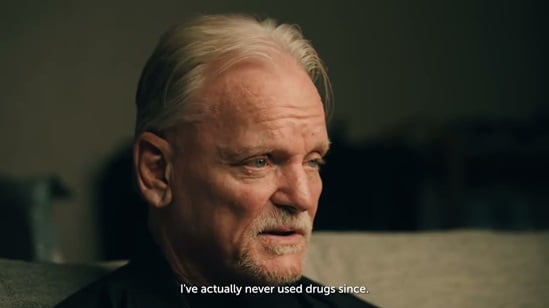
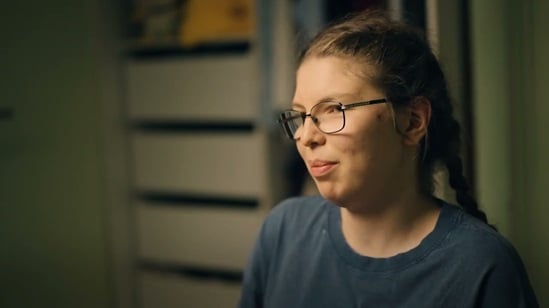
A man and his granddaughter wear face masks while sitting a distance apart from each other in a middle class household of north Delhi.
© Credits

Ageing

    Overview

    Every person – in every country in the world – should have the opportunity to live a long and healthy life. Yet, the environments in which we live can favour health or be harmful to it. Environments are highly influential on our behaviour and our exposure to health risks (for example, air pollution or violence), our access to services (for example, health and social care) and the opportunities that ageing brings. 

    The number and proportion of people aged 60 years and older in the population is increasing. In 2019, the number of people aged 60 years and older was 1 billion. This number will increase to 1.4 billion by 2030 and 2.1 billion by 2050. This increase is occurring at an unprecedented pace and will accelerate in coming decades, particularly in developing countries.

    This historically significant change in the global population requires adaptations to the way societies are structured across all sectors. For example, health and social care, transportation, housing and urban planning. Working to make the world more age-friendly is an essential and urgent part of our changing demographics.


    Impact

    Ageing presents both challenges and opportunities. It will increase demand for primary health care and long-term care, require a larger and better trained workforce, intensify the need for physical and social environments to be made more age-friendly, and call for everyone in every sector to combat ageism. Yet, these investments can enable the many contributions of older people – whether it be within their family, to their local community (e.g., as volunteers or within the formal or informal workforce) or to society more broadly.

    Societies that adapt to this changing demographic and invest in healthy ageing can enable individuals to live both longer and healthier lives and for societies to reap the dividends.

     
    WHO Response

    WHO works with Member States, UN agencies and diverse stakeholders from various sectors to foster healthy ageing in every country. Healthy ageing is defined as developing and maintaining the functional ability that enables well-being in older age. Functional ability is determined by the intrinsic capacity of an individual (i.e., an individual’s physical and mental capacities), the environment in which he or she lives (understood in the broadest sense and including physical, social and policy environments) and the interactions among them.

    WHO does this work in line with the Global strategy and action plan on ageing and health 2016–2020 and the related UN Decade of Healthy Ageing (2021–2030) in the following four action areas:

    • change how we think, feel and act towards age and ageing;
    • ensure that communities foster the abilities of older people;
    • deliver person-centred integrated care and primary health services responsive to older people; and
    • provide access to long-term care for older people who need it.


    News

    All →

    Our work

    All →
    Reducing social isolation and loneliness among older people

    Reducing social isolation and loneliness among older people

    Overview

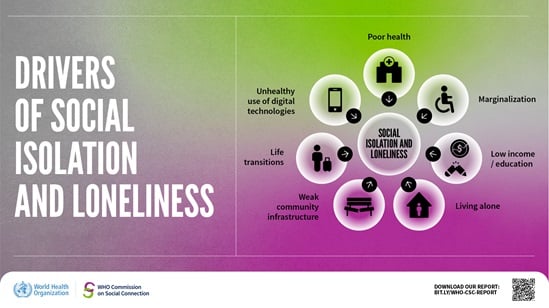
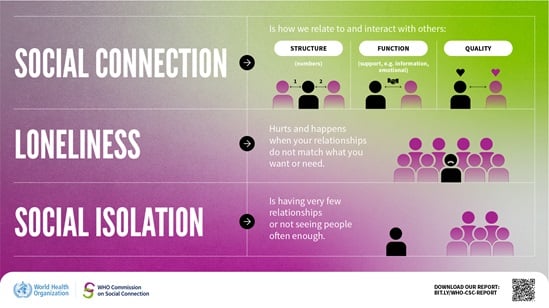
    Social isolation and loneliness are important, but often neglected, social determinants of health across all ages, including for older people. High-quality social connections are essential to our mental and physical health and our well-being.

    Social isolation and loneliness are widespread, with around 16% of people worldwide – one in six – experiencing loneliness. While the latest estimates suggest that loneliness is most common among adolescents and younger people, people of all ages experience loneliness – including older people, with around 11.8% experiencing loneliness. A large body of research shows that social isolation and loneliness have a serious impact on physical and mental health, quality of life, and longevity.

    A wide variety of face-to-face or digital interventions have been developed to reduce social isolation and loneliness among older people. These include social skills training, community and support groups, befriending, and cognitive behavioural therapy. Creating more age-friendly communities by improving access to transportation and information and communication technologies can also help reduce social isolation and loneliness. In addition, laws and policies that address marginalisation and discrimination can foster greater social connection.

    In the context of the UN Decade of Healthy Ageing (2021–2030), WHO is working with partners to address social isolation and loneliness as pressing public health and policy concerns by:

    • Developing guidance on how to implement and scale up effective interventions to reduce social isolation and loneliness;
    • Improving research and strengthening the evidence for what works; and
    • Creating a global coalition to increase the political priority of social isolation and loneliness among older people.

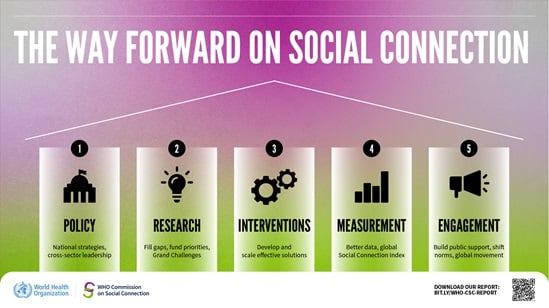
    Recognising that a life course approach is critical to promote social connection, including among older people, WHO has also established the Commission on Social Connection to see the issue recognised and resourced as a broader, global public health priority. The Commission has now released its flagship report, which brings together the latest evidence and data to show that social isolation and loneliness are widespread and have severe harms to our health and well-being, but also that solutions exist to address them.

    Latest publications

    All →
    Report of the fourth Life Course Network meeting, 18-19 November 2024 - Extending healthy ageing across the life course: connecting healthy development and healthy ageing
    Report of the 4th Life Course Network meeting, 18-19 November 2024 - Extending healthy ageing across the life course: connecting healthy development and...
    Integrated care for older people (‎ICOPE)‎: guidance for person-centred assessment and pathways in primary care, 2nd ed

    The ICOPE handbook supports health and care workers to put evidence- based recommendations into practice in primary care including community. The handbook...

    Framework to implement a life course approach in practice

    The WHO Framework to implement a life course approach in practice summarizes current evidence to reorient health systems to produce health and well-being,...