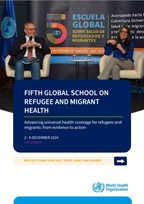
Refugee girl in health centre, standing by a pillar.
Refugee and migrant health
Today there are some 1 billion migrants globally, about 1 in 8 of the global population. These include 281 million international migrants and 82.4 million forcibly displaced (48 million internally displaced, 26.4 million refugees, 4.1 million asylum seekers)(1). UNHCR estimates there are many millions of stateless people globally.
The experience of migration is a key determinant of health and well-being. Refugees and migrants remain among the most vulnerable members of society faced often with xenophobia; discrimination; poor living, housing, and working conditions; and inadequate access to health services, despite frequently occurring physical and mental health problems.
The COVID-19 pandemic has posed additional challenges both in terms of increased risk of infection and death experienced by refugees and migrants and has highlighted existing inequities in access to and utilization of health services. Refugees and migrants have also suffered the negative economic impact of lockdown and travel restrictions.
Refugees and migrants need to be in good health to protect both themselves and host populations. They have the human right to health, and countries have an obligation to provide refugee and migrant sensitive health care services.
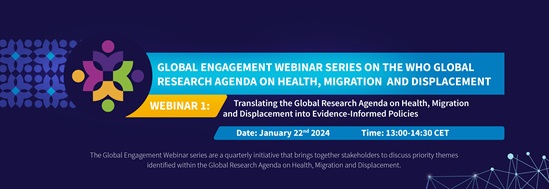
In 2020 WHO established the Health and Migration Programme (PHM) to provide global leadership in health and migration issues in the context of WHO’s own Global action plan: promoting the health of refugees and migrants 2019–23.
Refugees and migrants often come from communities affected by war, conflict or economic crisis, with vulnerabilities related to the condition of their journeys such as inadequate access to food and water, sanitation and other basic services. They are at risk of communicable diseases, accidental injuries, hypothermia, burns, unwanted pregnancy and delivery-related complications, and various noncommunicable diseases. Moreover, refugees and migrants are at risk of poor mental health outcomes. Refugee and migrant health are also strongly related to the social determinants of health in host communities (e.g., employment, income, education and housing).
To promote public health protection for them and the host populations, refugees and migrants should have equitable access to quality health services, free of discrimination, exclusion and stigma. In addition, appropriate multisectoral public policy responses are required to address the social determinants.
Refugees and migrants also play a key employment role in the provision of health and social services, and access to health services for the populations recognizes this contribution and contributes to social well-being and cohesion.
The WHO Health and Migration Programme (PHM) works with countries to promote the human right to health and access to quality and culturally appropriate health services, with adequate social and financial protection.
The WHO Global action plan: promoting the health or refugees and migrants (GAP) was agreed by the World Health Assembly in 2019. The GAP is part of an international framework established by the United Nations to manage global migration positively, including the Sustainable Development Goals (SDGs), and two global compacts, the Global Compact on Refugees (GCR) and the Global Compact for Safe, Orderly and Regular Migration (GCM).
The WHO Global action plan has six key priorities:
- promote the health of refugees and migrants through a mix of short-term and long-term public health interventions;
- promote continuity and quality of essential health care, while developing, reinforcing and implementing occupational health and safety measures;
- advocate the mainstreaming of refugee and migrant health into global, regional and country agendas and the promotion of refugee-sensitive and migrant-sensitive health policies and legal and social protection; the health and well-being of refugee and migrant women, children and adolescents; gender equality and empowerment of refugee and migrant women and girls; and partnerships and intersectoral, intercountry and interagency coordination and collaboration mechanisms;
- enhance capacity to tackle the social determinants of health and to accelerate progress towards achieving the Sustainable Development Goals, including universal health coverage;
- strengthen health monitoring and health information systems; and
- support measures to improve evidence-based health communication and to counter misconceptions about migrant and refugee health.
WHO Health and Migration Programme (PHM) aims to implement the Global action plan to promote and secure the health rights of refugees and migrants by providing global leadership in health and migration issues.

/health-and-migration-programme-(phm)/tag-meeting-report.tmb-144v.png?sfvrsn=5cedf5d2_1)