

Access to Oxygen Initiative
Foundations of medical oxygen systems
Foundations of medical oxygen systems has been complied to capture definitions, technical requirements, tools and resources related to medical oxygen systems based on information available in January 2023. This publication aims to make relevant and practical material accessible for Member States, policy makers, implementing partners, practitioners, biomedical engineers and technicians.
Key performance indicators for medical oxygen systems
Developing key performance indicators for the medical oxygen ecosystem through Delphi...
The COVID-19 pandemic has highlighted the importance of and inequities in access to life-saving medical oxygen. However, no consolidated list of Key Performance Indicators (KPI) exist to date to monitor these investments.
WHO lead a study to define the KPIs for monitoring global investments in medical oxygen.
These indicators can be used at global and national levels to measure performance and identify areas for improvement within the global medical oxygen response. This report summarizes the outcome of the survey and discusses next steps for the operationalization of the KPIs.
Operational guidance
All →The purpose of the regional manual, along with the operating guides, is to provide foundational information on key biomedical aspects of maintaining respiratory...
National medical oxygen scale-up plan: Development guidance
In line with WHA resolution 76.3 Increasing access to medical oxygen, WHO, Member States and partners, co-developed a guidance to strengthen the medical...
The Clinical Management and Operations Unit (Country Readiness Strengthening Department) in collaboration with the Medical Devices and Diagnostics Unit...

National oxygen scale-up framework: road to oxygen access: meeting report, Dakar, Senegal, 14–16 May...
The World Health Organization (WHO) convened a meeting in Dakar, Senegal, from May 14 to 16, 2024 to produce a template for developing evidence-based,...
Tools and resources for health care workers
All →

It is estimated that fewer than half of all health facilities in low- and middle-income countries haveuninterrupted access to medical oxygen, contributing...
Arising from an increased demand for medicinal gases, in particular the use of oxygen in the treatment of patients with coronavirus disease 2019 (COVID-19),...
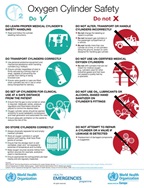
Oxygen Cylinder Safety
This poster is intended for health workers and other personnel on the safety and mitigation measures that need to be adhered to when dealing with medical...
Operational updates
All →
60-day ceasefire plan for Gaza
With the initiation of the first phase of the ceasefire in Gaza, humanitarian needs remain dire. In the current situation, it is crucial to scale up humanitarian...

WHO's Operational Update on Health Emergencies - January 2025
WHO's Operational Update on Health Emergencies, published monthly, highlights WHO’s work on preparedness and emergency response, combating health...

WHO's Operational Update on Health Emergencies - December 2024
WHO's Operational Update on Health Emergencies, published monthly, highlights WHO’s work on preparedness and emergency response, combating health...

WHO's Operational Update on Health Emergencies - November 2024
WHO's Operational Update on Health Emergencies, published monthly, highlights WHO’s work on preparedness and emergency response, combating health...
Oxygen regulations and standards
News
Other resources