

Our work in Myanmar

Our work in Myanmar

WHO/Myanmar
How to prevent the flu
© Credits

The World Health Organization (WHO) is a specialized agency of the United Nations system. WHO comprises member states, governing bodies and secretariat. WHO's overall objective is the attainment by all peoples of the highest possible level of health. The Organization was established on 7 April 1948 when its constitution took effect, a day which is commemorated annually as World Health Day.

The World health assembly is the highest governing body of the Organization, consisting of representatives of WHO's 192 member states. Six geographical areas have been delineated as regional organizations. The WHO South East Asia Region (SEAR) includes 11member states, of which Myanmar is one. The others are: Bangladesh, Bhutan, DPR Korea, India, Indonesia, Maldives, Nepal, Sri Lanka, Thailand, Timor Leste. Myanmar became a party to WHO's constitution on 1 July 1948. The WHO South-East Asia Regional Office (SEARO) is located in New Delhi, India.

WHO country office Myanmar, led by a Representative, provides technical and financial assistance to, and collaborates with, the Ministry of Health and Sports. WHO provides technical support to other major health partners, too. WHO's national and international staff provide support for technical assistance, capacity building, advocacy, policy development, standards and guidelines.

Myanmar-WHO Country Cooperation Strategy 2014-2018

WHO Country Cooperation Strategy: 2014-2018, Myanmar
The Country Cooperation Strategy (CCS) is WHO’s strategic framework to guide the Organization’s work in and with a country.

The Country Cooperation Strategy (CCS) for Myanmar is a medium-term vision of the World Health Organization's efforts to support health development in Myanmar in the next four years. It is based on analysis of the current health situation in the country, Myanmar Health Vision 2030, the National Health Policy, the strategies and priorities of the National Health Plan 2011–2016 and the UN Strategic Framework 2012–2015. The work of developmental partners in health and the work of WHO in the previous CCS cycle were also considered. The strategies were developed within the framework of the Twelfth General Programme of Work and special consideration was also given in enhancing the achievement of the Millennium Development Goals (MDGs), principally of the health targets by 2015. Throughout the process a close consultation was maintained with the Ministry of Health. The strategic agenda outlined in the document presents the priorities and actions that WHO can most effectively carry out to support health development, guiding the work of WHO in Myanmar at all level of the Organization. The strategic agenda for WHO's work in Myanmar will centre around five priorities: (1) strengthening the health system; (2) enhancing the achievement of communicable disease control targets; (3) controlling the growth of noncommunicable disease; (4) promoting health throughout the life course; and (5) strengthening capacity for emergency risk management and surveillance systems to various health threats. The priority areas will be addressed through a coordinated programme of work that will seek to harness the potential strengths of the stakeholders. For each of the strategic priorities, a set of main focuses and strategic approaches have been formulated. The WHO Country Office will be strengthened and reorganized in teams working on these priority areas.


Five strategic priorities of WHO in Myanmar

Strategic priority 1:

Strengthening the health system

Strategic priority 2:

Enhancing the achievement of communicable disease control targets

Strategic priority 3:

Controlling the growth of noncommunicable disease burden

Strategic priority 4:

Promoting health throughout the life course

Strategic priority 5:

Strengthening capacity for emergency risk management and surveillance systems

Publications and information resources

"မြန်မာနိုင်ငံ၌ ကိုဗစ်-၁၉ ရောဂါလူနာအား အိမ်တွင်းလူနာအဖြစ်ပြုစုကုသခြင်းလမ်းညွှန်" လက်စွဲမှာ ကမ္ဘာ့ကျန်းမာရေးအဖွဲ့၏ ကမ္ဘာလုံးဆိုင်ရာလမ်းညွှန်ကို အခြေခံ၍...

cover_COVID19 Case Management Guideline for Home-based Care in Myanmar_11 Oct 21

This guideline is intended to help the health care providers who are providing life-saving medical treatment to COVID-19 patients in the context of home-based...

The first case of COVID 19 was detected in Myanmar on the 23rd of March 2020 in a returnee from abroad followed by a gradual rise of cases which constituted...

မြန်မာနိုင်ငံတွင် ကိုဗစ်-၁၉ ပထမလှိုင်းကို နိုင်ငံခြားမှပြန်လာသူတစ်ဦးထံမှ မတ်လ (၂၃)ရက်၊ ၂၀၂၀ ခုနှစ်တွင် စတင်တွေ့ရှိပြီး မေလ၊ ၂၀၂၀ ခုနှစ်တိုင်အောင် ရောဂါတွေ့ရှိမှု...

The Structured Operational Research and Training Initiative (SORT IT) is a global partnership-based initiative coordinated by TDR, the UNICEF/UNDP/World...

Our activities

All →
Transition of Active Case Finding of TB cases in Yangon during crisis

Transition of Active Case Finding of TB cases in Yangon during crisis

Photo credit: Pyigyikhin Team
Chest X-ray screening during a mobile visit
© Credits

Overview

TB problem in Yangon is huge, serious and very complex. TB prevalence continues to exceed 600/100000 population and 47 percent of the drug resistant TB are reported form the capital. Thirteen percent of the cases have TB-HIV coinfection.  Proportion of TB cases detected that were screened for TB is high (91%). However, amongst people living with TB, 15 percent was started on Tuberculosis Preventive Treatment.  
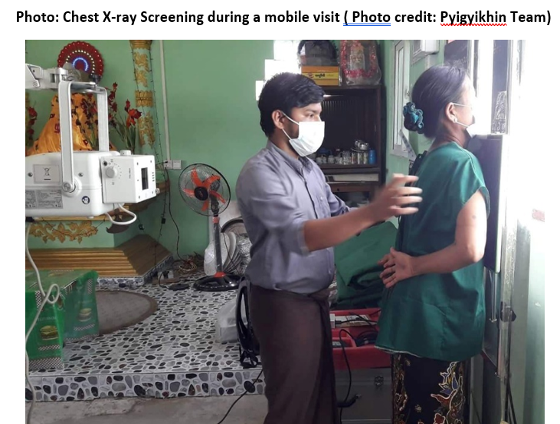
Chest X-ray screening during a mobile visit (Photo credit: Pyigyikhin Team)

To address the TB issue in Yangon, a more focused multisectoral and multi partner approach was required. As a result, “Yangon TB Consortium Project” was initiated in 2019 with four implementing partners (Myanmar Medical Association, Population Services International, Pyigyikhin, and Myanmar Anti-TB Association). The project functions under the leadership of the Regional Health Department through technical assistance of National TB Programme and WHO. At the township level, project activities are implemented under the supervision of Township health departments.  

Active case finding of TB using mobile teams, and engagement with Public-Private Mix (PPM) clinics, engaging communities for treatment and adherence support are the main approaches of the consortium project. The project is being implemented in seven townships of Yangon. At each township, mobile sites are selected quarterly depending on TB burden and different factors such as presence of vulnerable population and congested slum areas. 

Five mobile teams were recruited in this project. One mobile team has 5-6 team members (2 medical doctors for overall coordination and CXR reading/TB screening, 1 data assistant, 1 counsellor, 1 X-ray technician and 1 X-ray assistant). 

Chest X-ray screening followed by sputum examination is used as screening algorithm of mobile teams, and people aged 15 years and above are invited for screening regardless of TB symptoms. 

Community mobilization and invitation prior to mobile visits are conducted with the support of local administrative authorities, basic health service professionals (BHSP) and volunteers. Integrating TB screening in community based NCD clinics operated by basic health staff is also practiced. 

Mobile team activities started from May 2019, but had to be suspended in March 2020 due to COVID-19 outbreak in Yangon as the city went on prolonged lock down. At the end of 2020, modified SOP of mobile team considering risk mitigation in COVID-19 settings was developed by National TB Programme with technical assistance of WHO. Mobile team activities were restarted in early 2021, however due to political conflict in the country, all mobile activities have been suspended since 1st February 2021.

The Active Case detection was effective in case finding. During the nine months of the project, over 45,000 people were screened. About 1,200 TB patients were detected. Among the diagnosed patients, 83% received TB treatment. Low participation of community in TB screening and refusal to treatment are found as major challenges in urban settings possibly due to TB stigma and specially when the cases are asymptomatic. 

In times of political instabilities in Myanmar, there was minimum availability of public health services. During such times, “Mix clinics” under Myanmar Anti-TB Association have supported treatment continuation of TB patients. Treatment adherence support was ensured in collaboration with community partners. Currently, mobile team activities are redesigned into TB diagnostic facilities at charity clinics, community fever clinics and private sectors. 

WHO team continues to promote and support efforts at community engagement and train the staff and volunteers to increase TB case finding, contact investigation, Infection Prevention and Control and TB Preventive Treatment (TPT). If the ongoing political crisis continues, the Mobile clinics will be remodeled into facility-based service outlets. Community Based TB Care (CBTBC) network will identify suspected cases and refer to these clinics for diagnosis of TB. CBTBC engagement and ownership will be the key to compliance and treatment success and above all to find missing TB cases in the community during these critical times.