
2019
First WHO guideline on self-care interventions
WHO publishes its first consolidated guideline on self-care interventions for health and, focusing on sexual and reproductive health (SRHR). This guideline is a milestone for WHO. It is an important paradigm shift in normative guidance from WHO and paves the way for the years ahead in linking primary health care, communities and health systems.

WHO, HRP
2019
Research on self-care interventions
From 2019 onwards, interest in self-care for health and well-being grows as does the research taking place globally, leading to advances in knowledge, better understanding, informed policies and increased services.
2021
Classification of self-care interventions for health
A shared language for researchers, policy-makers, donors and health programme managers to describe the uses of self-care interventions. The classification is health systems focused and aims to promote an accessible language in five key areas: synthesizing evidence and research; promoting advocacy and communication; conducting national inventories and landscape analyses; articulating needs based on identified health system challenges; formulating operational considerations for implementation guidance.
2021
Sexual and reproductive health and rights: infographic snapshots
Produced for 194 WHO Member States, these snapshots highlight the national SRHR situation including for self-care interventions. Using the latest available data, these snapshots can be used for determining priorities, planning of programmes, resource mobilization, and strengthening of health systems, service delivery and community engagement.
Sexual and reproductive health and rights: infographic snapshot
2022
WHO guideline on self-care interventions for health and well-being, 2022 revision
This document builds on the 2019 guideline and brings together new and existing WHO recommendations, good practice statements and key considerations on self-care interventions for health. This expanded guideline includes additional interventions such as self-injection of contraception, self-management of medical abortion, and digital health tools. The guideline is also available in French, Spanish, Japanese and Russian.
WHO guideline on self-care interventions for health and well-being, 2022 revision

WHO, HRP
2022
A series of technical briefs on self-care interventions are published
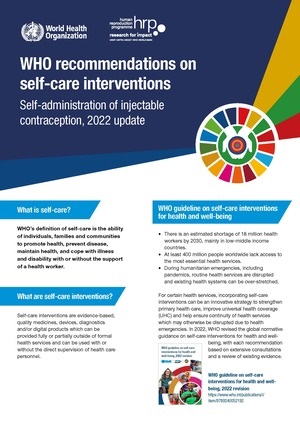
Following the 2022 revision of the WHO guideline on self-care interventions for health and well-being, a series of technical briefs are published, starting with Self-administration of injectable contraception.
The other briefs are: Self-management of medical abortion; self-collection of samples for sexually transmitted infections; Human papillomavirus (HPV) self-sampling as part of cervical cancer screening and treatment; Availability of lubricants during sexual activity and Making over-the-counter emergency contraceptive pills available without a prescription.
WHO
2023
Self-care competency framework: volumes 1-3
Materials are produced to train health and care workers to support self-care in their clinical practices. The three volumes are: the global competency standards; knowledge guide and curriculum guide for health and care workers to support people’s self-care. The three volumes are also available in French and Spanish.
/sexual-and-reproductive-health-and-research-(srh)/hrp-secretariat-(srt)/self-care-competency-framework-volume-1.tmb-549v.jpg?Status=Master&sfvrsn=68f6f0fc_1)
WHO, HRP
2023
WHO SRMNCAH policy survey
For the first time, the WHO sexual, reproductive, maternal, neo-natal, child, and adolescent health (SRMNCAH) survey includes specific questions to assess the existence of national laws, policies, strategies, and guidelines related self-care interventions for sexual and reproductive health. The results, published in 2024, showed that more than 50 countries now have a national policy and/or guideline.
/sexual-and-reproductive-health-and-research-(srh)/hrp-secretariat-(srt)/self-care-for-advancing-srhr-map.tmb-549v.jpg?Status=Master&sfvrsn=44e52b55_1)
WHO
2023
Self-care interventions for SRHR to advance universal health coverage
A joint statement by HRP, WHO, UNDP, UNFPA and the World Bank is launched on the side-lines of the World Health Summit. The co-endorsers of this statement support collective, coordinated and coherent action among United Nations partners to promote, enable and sustain the paradigm shift in ensuring equitable, evidence-based action on self-care interventions for SRHR. The joint statement is also available in French and Spanish.
/sexual-and-reproductive-health-and-research-(srh)/hrp-secretariat-(srt)/self-care-interventions-for-srhr-to-advance-universal-health-coverage.tmb-549v.jpg?Status=Master&sfvrsn=284b4706_1)
WHO, HRP
2023
Self-Care Wheel
A combined paper and digital tool, the Self-Care Wheel illustrates the evidence-based recommendations in the self-care guideline in a straightforward and easy-to-understand way.
Over the next two years, the Wheel is field-tested before a finalised version is released for countries to adapt based on local priorities and availability of specific interventions.
/sexual-and-reproductive-health-and-research-(srh)/hrp-secretariat-(srt)/self-care-wheel-guide-fig-1.tmb-549v.jpg?Status=Master&sfvrsn=4f07b8f3_1)
HRP
2024
Course on contraceptive counselling and prescribing
The WHO Academy learning course for pharmacists and pharmacy staff is released online. The course is to support wider access to contraception, particularly in low-resource settings, and is available in Arabic, Chinese, English, French, Russian and Spanish.
/sexual-and-reproductive-health-and-research-(srh)/hrp-secretariat-(srt)/counselling-and-prescribing-of-contraception-in-pharmacies.tmb-549v.png?Status=Master&sfvrsn=eac4322d_2)
WHO
2024
Implementation of self-care interventions for health and well-being: guidance for health systems
Building upon the latest normative recommendations and good practice statements from WHO, this guidance includes key considerations to support the introduction and scale-up of self-care interventions in countries, at the national or subnational level. The guidance is also available in French and Spanish.
Implementation of self-care interventions for health and well-being: guidance for health systems
/sexual-and-reproductive-health-and-research-(srh)/hrp-secretariat-(srt)/implementation-of-self-care-interventions-guidance-for-health-and-well-being-2024.tmb-549v.jpg?Status=Master&sfvrsn=ce64ab51_1)
WHO, HRP
2024
Self-care interventions for SRHR: country cases
This publication looks at self-care interventions for SRHR from a global perspective and also what is specifically happening in 6 countries: Burkina Faso, Ethiopia, India, Kenya, Nigeria and Uganda.
Self-care interventions for sexual and reproductive health and rights: country cases
/sexual-and-reproductive-health-and-research-(srh)/hrp-secretariat-(srt)/self-care-interventions-for-srhr-country-cases-2024.tmb-549v.jpg?Status=Master&sfvrsn=e7afee36_1)
WHO, HRP
2025
Generic protocol - Accelerating SRHR self-care interventions among underserved populations
A brief providing a generic protocol for implementation research is published. The brief was developed to help build the evidence base on how self-care interventions for SRHR can be effectively introduced, scaled, and sustained, particularly for underserved individuals and communities.
2025
Official side-event at the 78th World Health Assembly
An official side-event - the Contribution of self-care to advance sexual and reproductive health and rights – takes place at WHA78.
The event attracts a lot of interest and is co-hosted by several country governments, donors, international federations and networks, and the UN’s Special Programme of Research, Development and Research Training in Human Reproduction (HRP).
/sexual-and-reproductive-health-and-research-(srh)/hrp-secretariat-(srt)/contribution-of-self-care-to-advance-sexual-and-reproductive-health-and-rights.tmb-549v.png?Status=Master&sfvrsn=bffe3b1_4)
WHO
2025
Digital adaptation kit for self-monitoring of blood pressure (SMBP) during pregnancy
The Digital adaptation kit translates the WHO guidance on self-monitoring of blood pressure during pregnancy from the WHO guideline for self-care interventions for health and well-being into a digital format and common language that can be used by Ministry of Health programme managers, and their digital health colleagues, as well as software developers.
Digital adaptation kit for self-monitoring of blood pressure during pregnancy
/sexual-and-reproductive-health-and-research-(srh)/hrp-secretariat-(srt)/digital-adaptation-kit-for-self-monitoring-of-blood-pressure-during-pregnancy.tmb-549v.jpg?Status=Master&sfvrsn=e5add32c_1)
WHO, HRP
2025
Dialogue on positioning self-care to advance health equity and resilience
Building on the success of the official side-event at WHA78, a dialogue is held towards the end of the year on positioning self-care to advance health equity and resilience. The event is co-sponsored by the Government of Australia, Kingdom of Belgium, Grand Duchy of Luxembourg, Republic of South Africa, Kingdom of Sweden, Republic of Uganda, Oriental Republic of Uruguay, the UNDP/UNFPA/UNICEF/WHO/World Bank Special Programme of Research, Development and Research Training in Human Reproduction (HRP), and the World Health Organization.
/sexual-and-reproductive-health-and-research-(srh)/hrp-secretariat-(srt)/dialogue-on-positioning-self-care-to-advance-health-equity-and-resilience.tmb-549v.jpg?Status=Master&sfvrsn=82b568a5_1)
WHO