
/59748.tmb-300v.png?sfvrsn=9885965b_2 "For the future - publication thumbnail")


Responding to emergencies
In the Western Pacific, WHO coordinates operational readiness and emergency response action across one of the world's most disaster-exposed regions —connecting partners, commodities and operational response expertise to protect health, serve the vulnerable and keep the Region safe.
WHO's emergency operations include: Response & Operations, ensuring rapid activation and delivery of supplies, personnel and partners when emergencies strike; Health Emergency Workforce, building national and regional capacity through emergency medical teams, outbreak response networks and public health emergency operations centres; and Strategic Initiatives, strengthening the partnerships and planning that underpin effective response.
Emergency response efforts are supported by a regional stockpile of emergency supplies, contingency funding mechanisms, and staff and partners ready to deploy and lead emergencies when called upon. Working with countries and partners — including Emergency Medical Teams and the Global Outbreak Alert and Response Network (GOARN) — WHO is committed to protecting health in all situations.
.jpg?sfvrsn=cc0ddb5a_2 "Cyclone Winston (2)")
Response & Operations
When emergencies strike in the Western Pacific Region, WHO activates rapidly — coordinating grading and risk assessments, deploying supplies from regional stockpiles, and activating partner networks
- 35 emergencies currently graded or protracted across the Western Pacific Region, including four global events and two country-level events in the Region
- Contingency Fund for Emergencies (CFE) actively funding response implementation in Cambodia (botulism outbreak) and Viet Nam (flooding response)
- Regional stockpile operations supporting rapid dispatch of medical supplies, including emergency kits and diagnostic tools, across the Pacific
Health Emergency Workforce
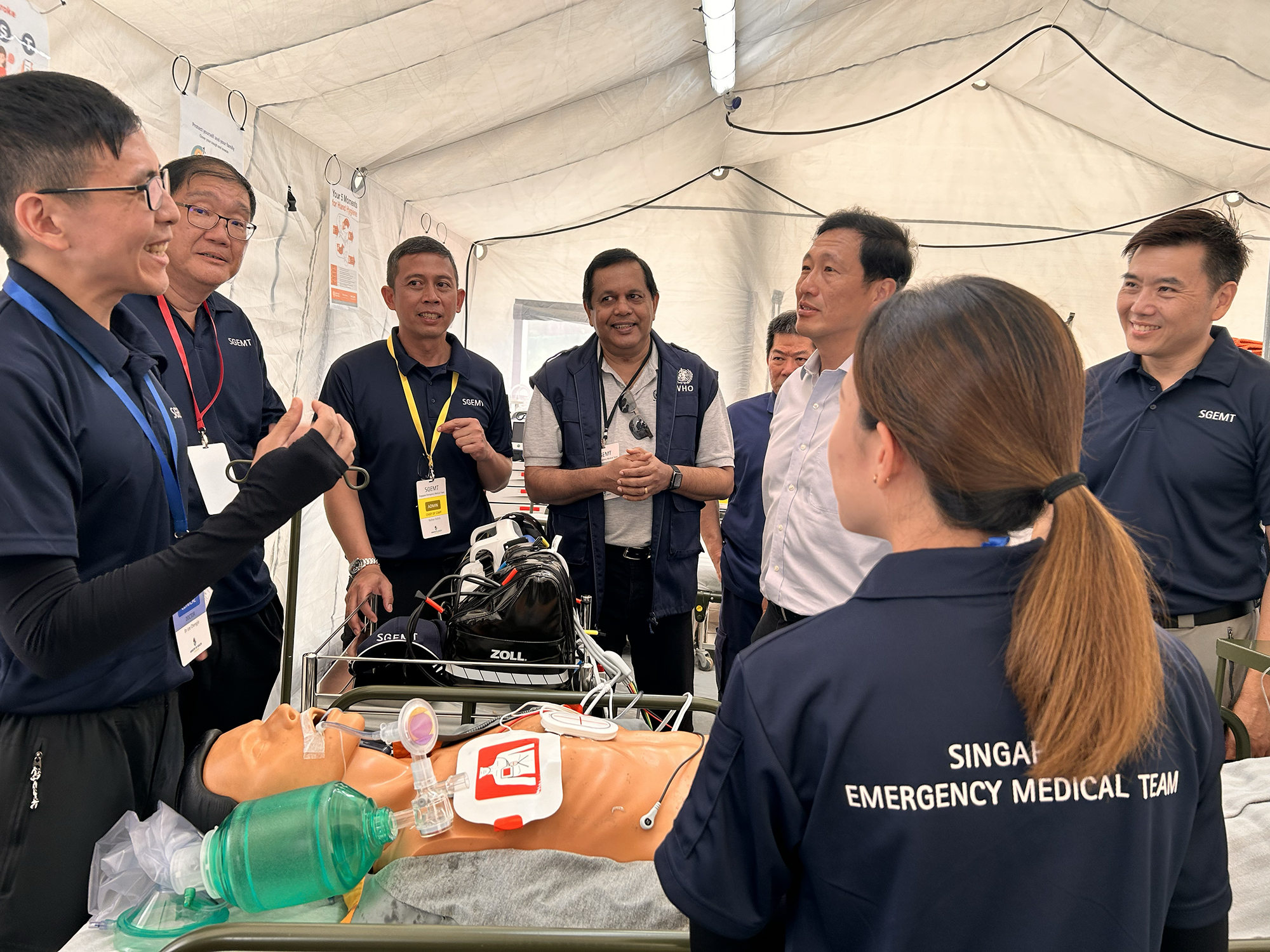
A strong emergency response depends on trained and structured surge capacities. WHO builds and sustains the health emergency workforce across the region — from classified Emergency Medical Teams to outbreak responders and public health emergency operations centres.
- 91 Global Outbreak Alert and Response Network partners across the region, with deployments actively supporting countries including Vanuatu and Viet Nam
- 18 WHO-classified Emergency Medical Teams in the Western Pacific, with 13+ additional teams in the classification pipeline — the most active EMT development region globally
- Several countries receiving support for Public Health Emergency Operations Centre (PHEOC) strengthening, with digital tools being rolled out
- Global Health Emergency Corps Fellowships launching a civil-military health security pilot, with future cohorts planned across multiple fellowship streams

Strategic Initiatives
Effective emergency response requires investment and coordination before emergencies happen. WHO's strategic initiatives strengthen the policy frameworks, partnerships and preparedness architecture that enable rapid, coordinated action across the region.
- Civil-military coordination advancing through a dedicated fellowship programme and the Indo-Pacific Health Security (IPhsa) architecture
- JERMAP (Joint External Risk Monitoring and Assessment for the Pacific) — a regional risk scenario framework that draws on best practices and hazard-based planning to connect mechanisms and partners, and to reduce fragmentation, to enable timely, reliable, and effective health emergency response
- 4 WHO Collaborating Centres (Hiroshima, NCCTRC Australia, China Foreign Affairs University, KDCA Korea) supporting specialized technical functions across the emergency operations portfolio
Latest updates