/committee-a-meeting-78th-wha.tmb-1920v.jpg?sfvrsn=f167b1ed_6)
Policy and governance
The 13th meeting of Committee A during the 78th World Health Assembly at the Palais des Nations in Geneva, Switzerland, on 27 May 2025.
Evaluation policy
The WHO Evaluation Policy (2025) builds on previous versions adopted by the Executive Board in 2012 and 2018, and incorporates lessons from WHO Governing Bodies, recent international evaluation normative guidance documents, and a WHO 2024 independent comparative review of evaluation functions and practices across the UN system. Reflecting evolving global challenges and increasing demands for accountability and results, the policy reinforces WHO’s commitment to high-quality, independent evaluation. It defines the vision, principles, and framework guiding WHO’s evaluation function, and aims to strengthen learning, transparency and evidence-based decision-making across all levels of the Organization.
With the aim of extending evaluation coverage and creating synergies among evaluations conducted across WHO, the implementation framework complements the WHO Evaluation Policy and presents mechanisms and support systems for the conduct of evaluation across all WHO offices.
Evaluation policy (2025)
Engagement with WHO governing bodies
The WHO Evaluation Office, as part of WHO’s Officer of Internal Oversight Services, operates independently and reports directly to the Director-General. It is accountable to the Executive Board through the Programme, Budget and Administration Committee (PBAC).
The Executive Board oversees the evaluation function, approves the Evaluation Policy and Organization-wide biennial evaluation workplans, and ensures the use of evaluation evidence in strategic planning and decision-making.
The Independent Expert Oversight Advisory Committee supports this governance structure by reviewing the performance, resourcing, and implementation of the evaluation function and advising both the PBAC and Executive Board, and the Director-General.
WHO Evaluation submits an annual report on evaluation activities to the PBAC and Executive Board at their May session.
Roles and responsibilities of governing bodies
Accountability for evaluation is shared across WHO’s three levels. The Executive Board (EB) provides oversight by approving the evaluation policy and biennial workplan, reviewing evaluation reports, and monitoring follow-up on key recommendations, supported by advice from the Independent Expert Oversight Advisory Committee on the performance, independence, and quality of the evaluation function.
The
Director-General, Regional Directors, Assistant Directors-General, and Budget
Centre Managers are responsible for championing evaluation, ensuring
adequate resourcing, commissioning and planning evaluations, monitoring
implementation of recommendations, and promoting the use of evaluation findings
to inform strategic and programme decision-making across the Organization.
2026–2027 Evaluation: update and proposed workplan (EB158/34)
2024–2025 Evaluation: update and proposed workplan (EB154/31)
2022–2023 Evaluation: update and proposed workplan (EB150/35)
2020–2021 Evaluation: update and proposed workplan (EB146/38)
2018–2019 Evaluation: update (EB144/51)
2018–2019 Evaluation: update and proposed workplan (EB142/27)
2016–2017 Evaluation: update and proposed workplan (EB138/44)
2016 Progress update: Report from the Secretariat (EB138/38 Add.1)
2014–2015 Evaluation: update (EB136/38)
2014–2015 Evaluation: update report and proposed workplan (EB134/38)
2013 Evaluation: update and proposed workplan for 2013 (EB132/30)
WHO annual reports to the governing bodies
WHO’s annual evaluation reports, submitted to the Executive Board through the Programme, Budget and Administration Committee (PBAC) at their May session, as required by the Organization’s evaluation policy, provide an update on the implementation of the evaluation function, including progress against the Organization-wide evaluation workplan. These reports highlight key evaluations completed, their findings and use, efforts to strengthen decentralized evaluation capacity, and steps taken to improve evaluation quality, independence, and utility. They also summarize stakeholder engagement, capacity-building initiatives, funding considerations, and lessons learned. In addition to the given Evaluation annual report published on WHO’s Governance webpage (respective PBAC and EB pages), a more detailed Annex to the report can be published on the WHO Member State Portal webpage.
Recent reports have included findings from comparative studies across UN agencies, helping to shape recommendations for strengthening WHO’s evaluation systems and informing future policy updates.
2024 Evaluation Annual Report (EB155/4)
2024 Evaluation Annual Report (EB155/4) Annex
2023 Annual Evaluation Report (EB153/6)
2022 Annual Evaluation Report (EB151/4)
2021 Annual Evaluation Report (EB149/5)
2020 Annual Evaluation Report (EB147/5)
2019 Annual Evaluation Report (EB145/6)
2018 Annual Evaluation Report (EB143/6)
2017 Annual Evaluation Report (EB141/7)
2016 Annual Evaluation Report (EB139/9)
2015 Annual Evaluation Report (EB137/7)
Biennial, organization-wide evaluation workplans
WHO’s biennial evaluation workplans provide a structured framework for planning and implementing evaluations across the Organization. These workplans set out priority topics and areas for evaluation, ensure alignment with WHO’s strategic objectives, and support evidence-based decision-making, accountability, and organizational learning.
Developed in consultation with senior management across the Organization and reviewed by the Independent Expert Oversight Advisory Committee (IEOAC), and Programme, Budget and Administration Committee (PBAC), the workplans are submitted to the Executive Board for approval at the January session at the beginning of a given biennium.
The current workplan for 2024–2025 was approved by the Executive Board in decision EB154(2), following review by the PBAC (document EB154/4), and is outlined in document EB154/31.

Evaluation workplan 2024–2025
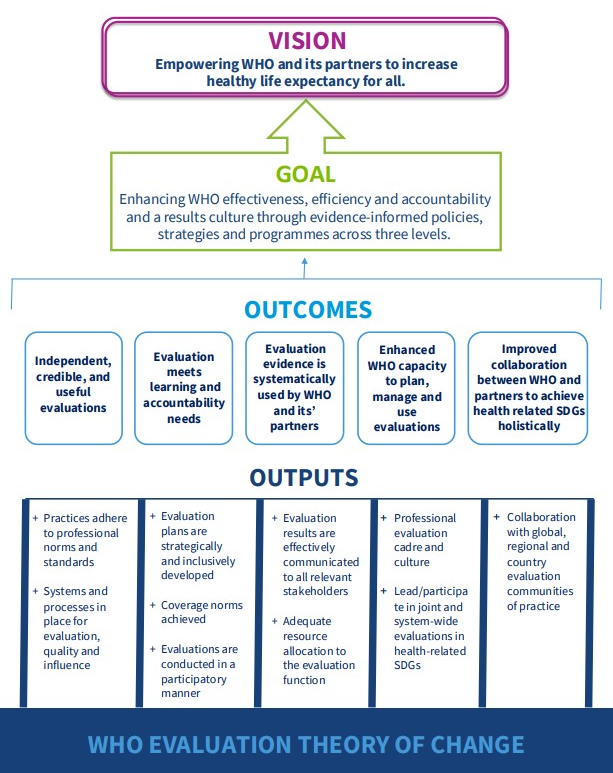
Theory of change
As contained in the WHO Evaluation Policy (2025), Theory of Change for the evaluation function outlines how high-quality, independent, and useful evaluations empower WHO and its partners to improve health outcomes and accountability. It shows the link between well-resourced, credible evaluation systems and their use in decision-making, learning, and transparency.
Through stakeholder engagement, strong norms and standards, and clear communication, the evaluation function contributes to a more effective WHO and supports progress toward health-related Sustainable Development Goals.