

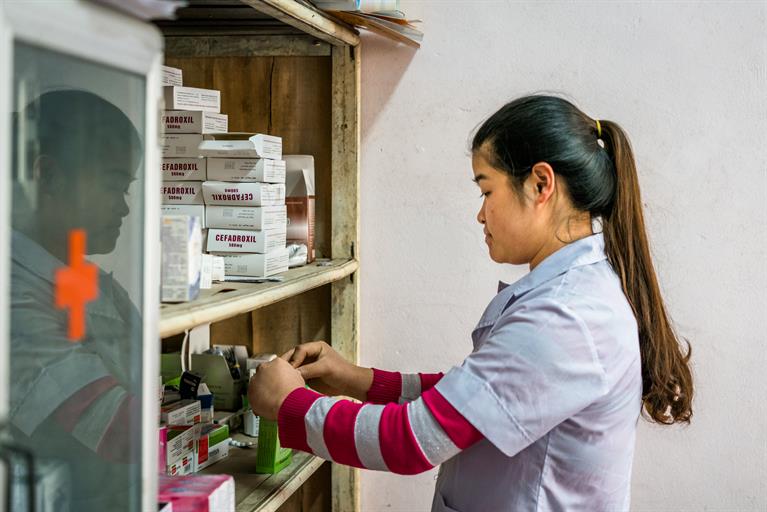

/access-to-medicines-and-health-products-adgo-(mha)/pharmacists-checking-medicines-stocks.tmb-1920v.jpg?sfvrsn=3b0196be_1)
Access to medicines and health products
Universal health coverage can only be achieved when there is affordable access to safe, effective and quality medicines and health products.
Countries face a range of obstacles to achieving this, including rising prices for new medicines; shortages and stock outs of essential medicines, especially for noncommunicable diseases, and the growing problem of substandard and falsified medical products entering the global supply chain. Added to this, there are other challenges to ensuring that medicines are not only available, but are used appropriately. Antimicrobial resistance has become a worldwide problem largely due to overuse, and misuse of opioids has led to an addiction epidemic in some countries. Knowing where to tackle the problem is the first step. WHO works with Member States to identify what their priorities are on the road to achieving this universal access.
Areas of work
Regulation and Prequalification
Progress towards enhancing regulatory practices related to medical products around the world is supported by capacity building, promoting regulatory convergence and harmonization.

Universal Health Coverage Day
Annually 12 December
Highlights
School of INN
Medicine price information
News
All →Our work
All →
Assessing the progress of Health Technology Assessment use
Overview
In order to better understand the state of Health Technology Assessment (HTA) processes around the world, the WHO HTA team monitors the use of HTA, and it’s related principles, through the administration of a global survey of Member State countries. The survey is also designed to monitor trends in the integration and development of HTA. The survey also serves as a resource to provide contact information for HTA focal points and to provide country profiles, which provide a snapshot of the state of HTA processes in a given setting.
World Health Assembly resolution WHA67.23 mandates the WHO Secretariat to assess:
- HTA methodology
- HTA human resources and institutional capacity
- HTA governance
- links between HTA units and networks with policy authorities
- utilization of HTA results
- interest in impediments to strengthening HTA capacity.
The initial survey was conducted in 2015 after the resolution was approved, with 111 member state responses. In 2020 and 2021, an update to this survey is being conducted with an additional component exploring the linkages with the design and contents of Health Benefit Packages. The survey results are expected to be available in the latter half of 2021.
Publications
All →The document outlines key concepts related to substandard and falsified medicines, including their sources, risks and impact on health systems and communities....
This report provides an overview of the Fifth WHO Global Forum on Medical Devices held from June 2 to 5, 2025, in Geneva, Switzerland through a virtual...
Whether or not xenotransplantation should be done is beyond the scope of this paper. Therefore, this paper does not examine the important ethical issues...
This comprehensive document deals with the relevant WTO agreements and the way they may influence health and health policies. In undertaking this joint...