Participant from Art competition, Universal Health Day celebrations-2022
Health System Governance
© Credits

Health financing

    Overview

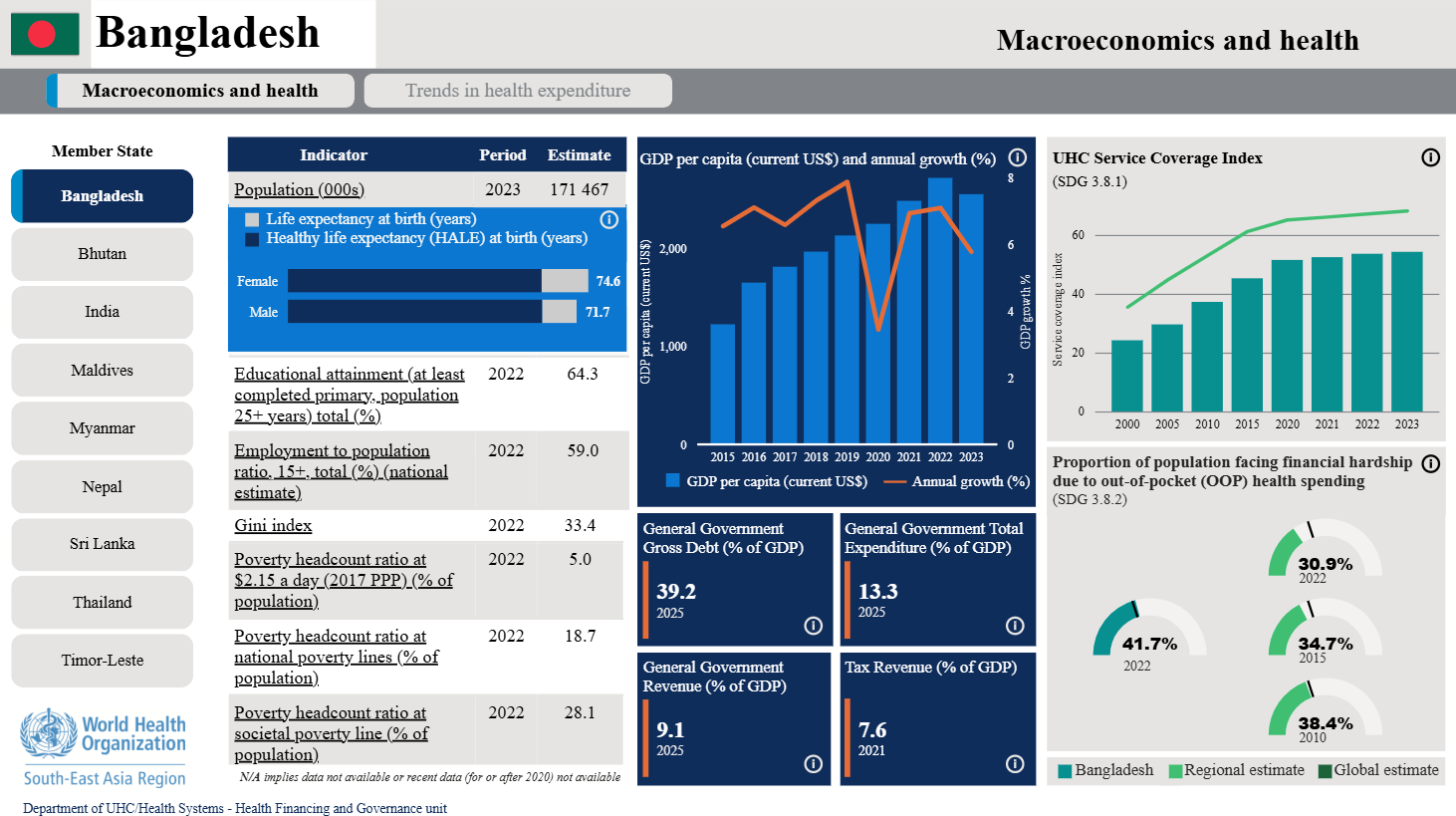
    Health financing and economics

    Health financing is a core function of health systems that can enable progress towards UHC by improving effective service coverage and financial protection.

    Health financing operates through three essential functions: revenue raising, risk pooling, and purchasing. Revenue collection refers to identifying and analyzing the sources of funds directed into the health system. Risk pooling involves distributing the financial burden of health care. Purchasing, which uses various payment mechanisms, plays a critical role in shaping how resources are allocated. Together, these functions provide valuable insights into the efficiency, equity, effectiveness, and sustainability of the health system, supporting progress towards UHC.

    While health financing reforms are hugely context specific, the guiding principles that accelerates progress towards UHC includes:

    • moving towards predominant reliance on public funding sources
    • reducing fragmentation in how funds are pooled
    • moving towards more strategic purchasing of health services, linking provider payments to performance, quality and equity
    • aligning coverage policies (benefits and copayments) explicitly with policy objectives. 
    Health economics 

     Value for money in health entails achieving the greatest possible health outcomes and equity gains from every unit of resource spent, ensuring efficiency, effectiveness and sustainability. This area of work in WHO covers technical and allocative efficiency: costing and budget impact, investment cases, health technology assessment, benefit package design and priority setting.

    Latest publications

    All →
    Rooted in partnership, growing through challenge: The Banyan Framework for Health and Well-Being in the WHO South-East Asia Region (2026–2028), 2026

    The Banyan Framework for Health and Well-Being in the WHO South-East Asia Region (2026–2028) sets out a clear, country-focused path to protect recent...

    Maldives Health Financing Progress Matrix Assessment Report

    This report summarizes the findings of the Health Financing Progress Matrix (HFPM) assessment for the Maldives, using WHO’s standardized qualitative...

    Lessons from case studies of social participation and its role in the pandemic response in the WHO South-East Asia Region, 2025

    Member States of WHO South-East Asia Region continue to strengthen social participation in health, as demonstrated by case studies from Bangladesh, India...

    Performance-based financing in the South-East Asia Region: A scoping review

    This report reviews performance-based financing reforms and experiences in the WHO South-East Asia Region. The review highlights how this health financing...

    Our work

    All →

    Documents

    All →
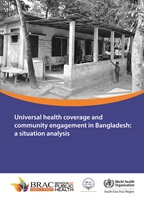
    Cover of document on "Universal health coverage and community engagement in Bangladesh"

    Universal health coverage (UHC), a global health agenda, has been ratified by most countries, including Bangladesh. It is well acknowledged that community...

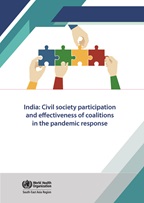
    Cover image of document on "India-Civil society participation and effectiveness of coalitions in the pandemic response""

    The good governance paradigm for public health embodies a whole-of-society approach, in which the engagement of civil society organizations (CSOs) is essential...

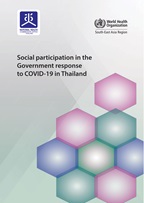
    Cover image of document on "Social participation in the Government response to COVID-19 in Thailand"

    Novel coronavirus disease 2019 (COVID-19), identified in late 2019, soon became one of the most severe global health crises, with impacts on every aspect...