
What is PPE?
Personal protective equipment or PPE is equipment used to prevent or minimize exposure to hazards such as:
- Biological hazards
- Chemical hazards
- Radiological hazards
- Electrical hazards
- Mechanical hazards
- Etc.
Without PPE, exposure could lead to injuries and illnesses. A range of industries use PPE to protect their workforce from occupational hazard. The construction, mining, chemical and pharmaceutical industries are among those using PPE on regular basis. Healthcare workers also use PPE to ensure safety during working hours.
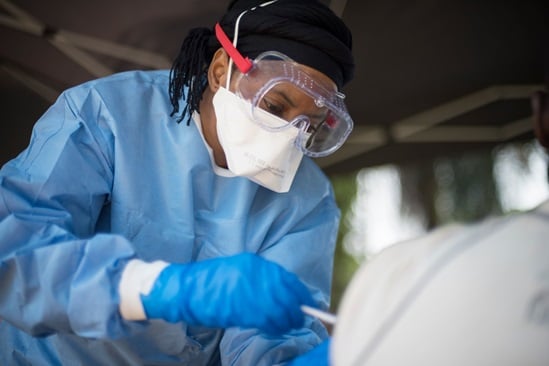
WHO’s response to Ebola virus disease (EVD) outbreak in the Democratic Republic of Congo, 2018. A member of the WHO Ebola ring vaccination team vaccinates a man in Bosolo village.
PPE and the Healthcare workforce
PPE protects healthcare workers from two main hazards:
- Radiation (Enhancing radiation safety in health care)
- Biological agents (virus, bacteria, etc.)
Biological agents transfer from person to person by direct or indirect contact. Health workers maintain close contact with patients. Thus, they need PPE that protects them from potential transmission. Important transmission pathways to mitigate with PPE include:
- Person to person contact
- Droplet spread
- Airborne transmission
- Contaminated objects (fomites)
The use of Infection prevention and control
(IPC) principles keep patients and health workers safe. IPC includes measures like: hand hygiene, PPE use and waste management materials. In addition, the WHO ensures the safety of the health workforce by providing guidance on the safe use of PPE.
Depending on the biological agent and context different recommendations apply. For example, some PPE recommended for Ebola virus disease (EVD) might not be adequate for COVID-19.
Over the years, the WHO has provided technical information on the PPE for health care workers. In some countries, PPE is considered a medical device by regulation authorities. The latest publications by WHO describe PPE in the context of:
According to this publications the main characteristics of PPE include:
| Category | Characteristic | |||||
| Design feature |
| |||||
| Material performance |
| |||||
| Use desirability |
|
Useful information to protect the health workforce and supply them with essential PPE is listed below (Publications and Documents).
NOTE: During the COVID-19 pandemic, the WHO and partners are providing a channel to request essential supplies. Countries can use the supply chain portal to request access to supplies like:
- PPE
- Biomedical Equipment
- Diagnostics
PPE and the Public
During the COVID-19 pandemic, PPE became a key player in reducing transmission among the general public. The WHO has developed regular advice for the public, including: When and how to use masks?
Publications
All →COVID-19 Essential Supplies Forecasting Tool
This document provides technical details and methodological explanations on the structure of the COVID-19 Essential Supplies Forecasting Tool (ESFT). It...
Rational use of personal protective equipment for coronavirus disease (COVID-19) and considerations during...
This document summarizes WHO recommendations for the rational use of personal protective equipment (PPE) in health care settings and temporary strategies...
Mask use in the context of COVID-19
This document provides updated guidance on mask use in health care and community settings, and during home care for COVID-19 cases. It is intended for...
Priority medical devices list for the COVID-19 response and associated technical specifications
This document describes the medical devices required for the clinical management of COVID-19, selected and prioritized according to the...
This document provides interim guidance on the quality, performance characteristics and related standards of personal protective equipment (PPE) to be...
What are the key characteristics of COVID-19-ESFT? The WHO COVID-19 Essential Supplies Forecasting Tool (COVID-19-ESFT) is meant to help countries...
Documents
All →


