WHO / Jo-Ann Muriel
© Credits

Healthy diet

    Overview

    A healthy diet is a foundation for health, well-being, optimal growth and development. It protects against all forms of malnutrition. Unhealthy diet is one of the leading risks for the global burden of disease, mainly for noncommunicable diseases such as cardiovascular diseases, diabetes, and cancer.

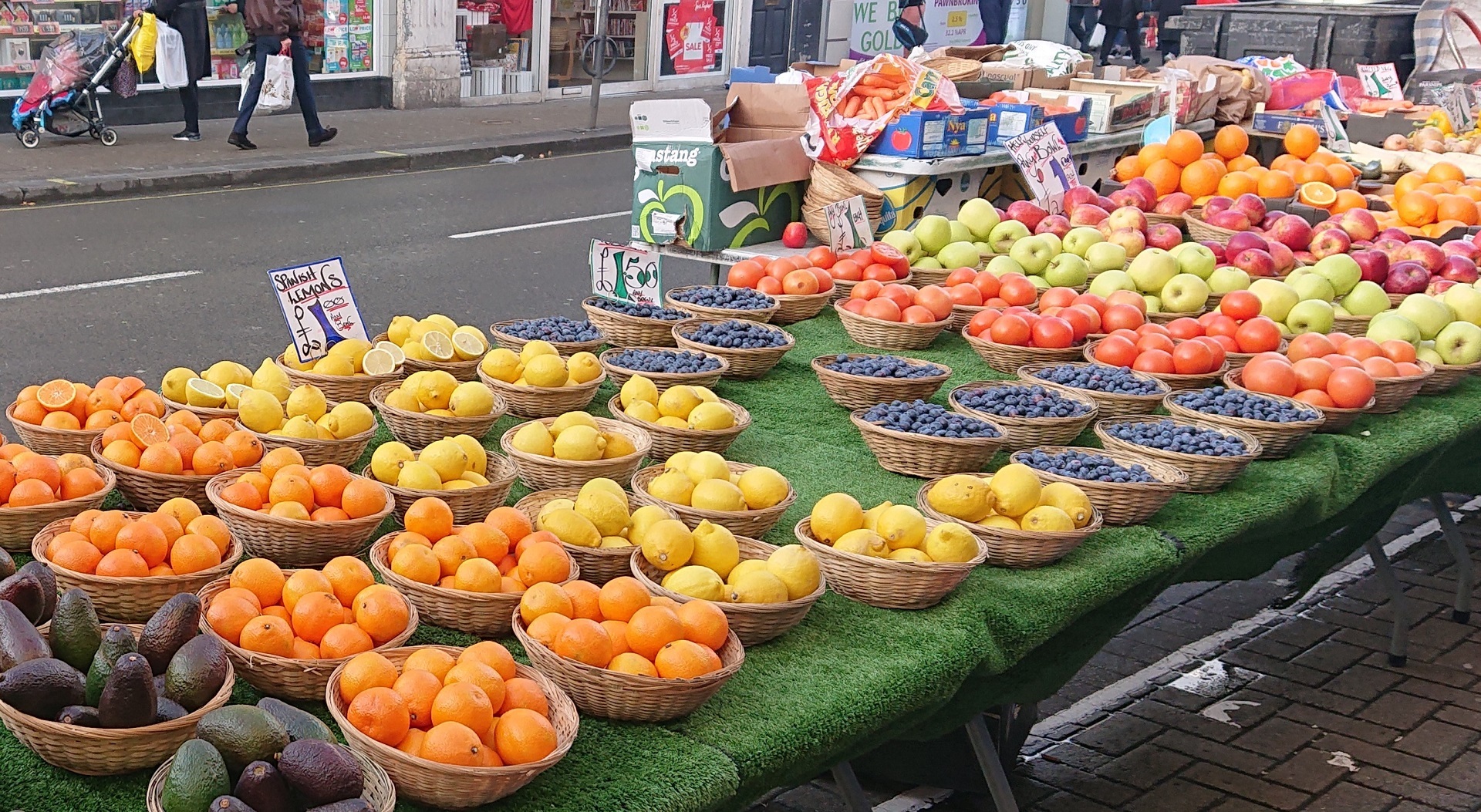
    Evidence shows the health benefits of a diet high in whole grains, vegetables, fruit, legumes and nuts, and low in salt, free sugars and fats, particularly saturated and trans fats. A healthy diet starts early in life with adequate breastfeeding. The benefits of a healthy diet are reflected in higher educational outcomes, productivity and lifelong health.

    A healthy diet is also more environmentally sustainable, as it is associated to lower greenhouse gas emissions, lower use freshwater and land mass.

    However, healthy diets can be inaccessible, particularly in low- and middle-income countries, and also in places and situations with high rates of food insecurity. Around the world, an estimated 3 billion people cannot access safe, nutritious and sufficient food. In addition, the proliferation of highly processed food, supported by aggressive marketing, rapid unplanned urbanization and changing lifestyles have contributed to more people eating unhealthy diets high in energy, free sugars, salt, saturated fats and trans fats.

    Recommendations

    What constitutes a healthy diet may differ depending on individual needs, locally available foods, dietary customs, cultural norms and other considerations. However, the basic principles of healthy diets remain the same for everyone. The nature of access to food requires broader solutions at the societal level to promote safe and healthy food options.

    WHO recommends

    • to meet the needs of energy, protein, vitamins and minerals through a varied diet, largely plant based, and balancing energy intake with expenditure;
    • obtaining the largest amount of energy from carbohydrates, mainly through legumes and wholegrain cereals;
    • reducing total fats to less than 30% of total energy intake, shifting fat intake away from saturated and trans fat to unsaturated fats, and eliminating industrial trans fats from the diet;
    • reducing free sugars to less than 10% (ideally 5%) of total energy intake;
    • limiting sodium intake to less than 2 grams per day (equivalent to 5 grams of salt); and
    • consuming at least 400 grams of vegetables and fruit per day in adults and children above 10, and 250–350 grams per day in younger children.
    WHO response

    WHO continuously updates the guidance on what constitutes a healthy diet to prevent all forms of malnutrition and promote well-being in different population groups across the life course and on how different nutrients and foods contribute to it.

    WHO develops evidence-informed guidance on improving the food environment, such as school food and nutrition policies, public food procurement policies, nutrition labelling policies, policies to restricting marketing foods and beverages to children, and fiscal policies (i.e., taxation and subsidies). WHO engages with food manufacturers on improving the nutrition profile of their products.

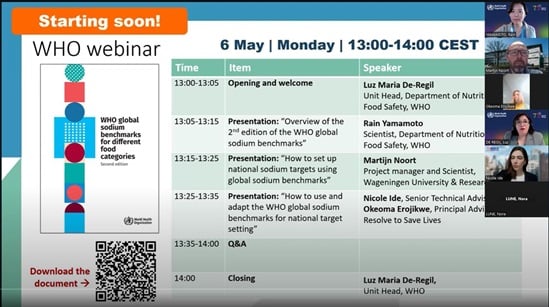
    WHO supports Member States in adopting and implementing policies by providing tools such as systems to characterize the nutrient profiles of foods, benchmarks for sodium content in food, manuals on how to implement fiscal policies and marketing restriction policies.

    WHO regularly monitors the adoption and implementation of food environment policies and their impact on population dietary intake and health.

    News

    All →

    Publications

    All →
    Evaluation of certain contaminants in food: one-hundred-and-first meeting report of the Joint FAO/WHO Expert Committee on Food Additives

    OverviewThe one-hundred-and-first meeting of the Joint FAO/WHO Expert Committee on Food Additives (JECFA) was held in Geneva from 15 to 21 October 2025....

    Informed decision‑making in public private partnerships for physical activity and healthy diets

    In a context where noncommunicable diseases (NCDs) are rising and unhealthy diets are increasingly prevalent, governments often face significant uncertainty...

    The WHO acceleration plan to stop obesity: a joint WHO/UNICEF operational model for designing and implementing the response

    Obesity is one of the most urgent public health challenges of our time. In 2022, more than 1 billion people worldwide were living with obesity, a number...

    Policies and interventions to create healthy school food environments: WHO guideline

    Children spend a large share of their day in school, making it a critical setting for shaping lifelong dietary habits and reducing health and nutrition...

    Documents

    All →
    Report for the 1st Asia-Pacific Region Workshop on Total Diet Studies cover

    With our diet, we ingest many substances every day, which can either be beneficial or potentially harmful. The chronic exposure to some of these substances...

    Cover image

    This edition of the NFS Newsletter features key activities the Department of Nutrition and Food Safety undertook in January and February 2026. 

    NFS newsletter Sep-Oct 2025 cover

    This edition of the NFS Newsletter features key activities we undertook in September and October 2025. 

    This document was prepared in support of the publication "WHO reference protocol for measuring fatty acids in foods, with emphasis on monitoring trans-fatty...

    Infographies

    All →

    Videos

    All →

    Podcasts

    Episode #91 - Everything you need to know about trans fat

    WHO is urging action by Governments and the food industry to remove industrial trans fat from our food chain. Which foods contain trans fat? How do they harm us? WHO’s Dr Francesco Branca explains in Science in 5.
    Presented by
    Vismita Gupta-Smith

    Alternative media

    Transcript

    VGS   Hello and welcome to Science in 5. I'm Vismita Gupta-Smith We are talking to Dr Francesco Branca, today. Welcome Francesco. Francesco, let's start with what kind of foods contain trans fat?

    FB   There are two kinds of trans fat, natural trans fat and industrial trans fat. The natural trans fat are contained in dairy products or in the meat of ruminant animals such as cows. Both trans fat are bad for our health. The industrial trans fat are the largest proportion. The value of this product for the manufacturers is the fact that they have a longer shelf life and they're also cheaper. Partially hydrogenated oils are used in products such as margarine, vanaspati ghee and they're used in baked products such as donuts or fried food or baked food that you often find in street food.

    VGS   Francesco, describe to us what trans fat do to our body when we consume them.

    FB   So when trans fat enter our body, they're taken up by certain compounds that transport fat in the blood flow. And the more the trans fat, the higher the amount of bad cholesterol that is produced and the lower the amount of the good cholesterol.

    So you have more of this bad cholesterol, which then means higher amount of hardening of the cell walls and inflammation of the cell walls. And this leads to a higher risk of clogging of the arteries and therefore a higher risk of heart disease and stroke.

    Consumption of trans fat at the current level is estimated to increase that by 21% that is by one-in-five the risk of getting heart disease. And by even more one-in-four times the risk of dying from heart disease. And so we calculate that with the current level of consumption of trans fat, something in between 300 000 and 500 000 people every year die as a result of the consumption of this toxic compound. And if we remove this compound from the food system, we will be able to save millions of lives.

    VGS   Francesco, how can we remove trans fat from our food chain? And has any country done it?

    FB   So let me start by saying that trans fat are bad for your health. So removing them will give you health benefits and you would not even realize that trans fat is being removed because there's no change in taste, no change in the cost of food. It's possible to remove trans fat and replace it with other ingredients, vegetable oils such as canola oils or other vegetable oils and manufacturers know how to do that. It's important that countries nudge manufacturers through adequate regulations. WHO has identified the most effective regulations which imply limiting the amount of trans fat below a certain very minimum level that comes usually from all natural sources. Or banning the sales and production of industrial trans fat.

    Now we have 43 countries who have passed legislation in the last years, and this number has grown very quickly in the last few years as a result of public health campaigns. Largely, these countries are from the global north - high income countries.

    But since last year, we've had countries such as India and Bangladesh who have passed regulations in line with the WHO good practices. And we have good expectation that other countries such as Nigeria this year will also pass legislation.

    At the moment we have 3 billion people in the world who are covered by the risk of exposure to trans fat because they live in countries where legislation is strong. But we need to cover the rest of the world, and we really count on the collaboration of all actors, government actors, but also manufacturers of food, oil manufacturers to all work towards what could be an impressive public health achievement and in fact, the elimination of the first risk factor for non-communicable diseases such as heart disease.

    VGS   Thank you, Francesco. That was Science in 5 today. Until next time then, stay safe, stay healthy and stick with science.

    Speaker key

    • FB Francesco Branca
    • VGS Vismita Gupta-Smith

    Related health topics