Food safety
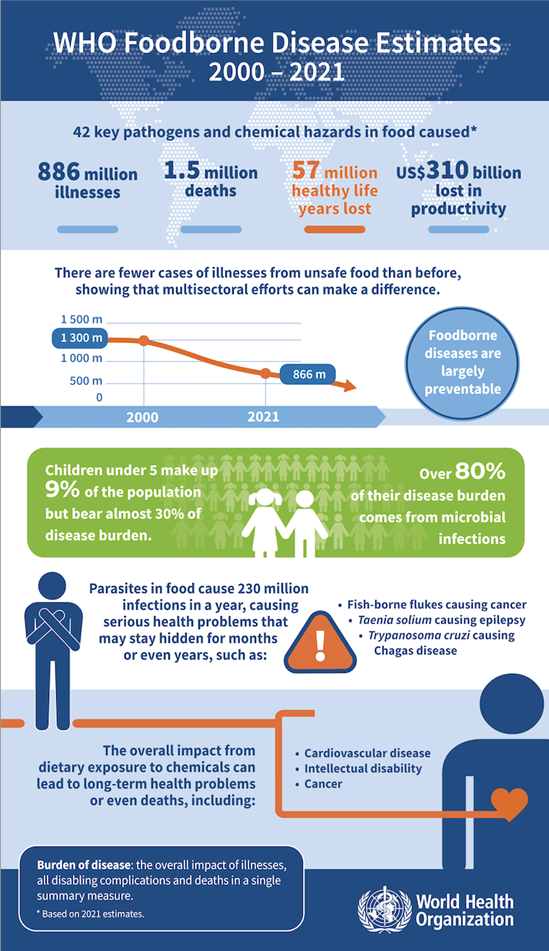
Access to enough safe and nutritious food is key to sustaining life and promoting good health. Unsafe food containing harmful bacteria, viruses, parasites or chemical substances can cause more than 200 different diseases, ranging from diarrhoea to cancers. Around the world, an estimated 866 million – almost 1 in 9 people – fall ill after eating contaminated food each year, resulting in 1.52 million deaths and the loss of 57.1 million healthy life years (DALYs).
Food safety, nutrition and food security are closely linked. Unsafe food creates a vicious cycle of disease and malnutrition, particularly affecting infants, young children, elderly and the sick. In addition to contributing to food and nutrition security, a safe food supply also supports national economies, trade and tourism, stimulating sustainable development. The globalization of food trade, a growing world population, climate change and rapidly changing food systems have an impact on the safety of food. WHO aims to enhance the capacity to prevent, detect and respond to public health threats associated with unsafe food at the global and country levels.
Foodborne diseases impede socioeconomic development by straining health care systems and harming national economies, tourism and trade. The burden of foodborne diseases to public health and to economies has often been underestimated due to underreporting and difficulty to establish causal relationships between food contamination and resulting illness or death. Children under 5 bear nearly one-third of all cases of foodborne diseases, particularly diarrhoeal diseases, which can be deadly for this vulnerable group.
The consumption and production of safe food have immediate and long-term benefits for people, the planet and the economy. Safe food is essential to human health and well-being, only food that is safe can be traded. Safe food allows for the uptake of nutrients
and promotes long-term human development. When food is not safe, humans cannot develop, and the Sustainable Development Goals cannot be achieved.
The WHO report on the global burden of foodborne diseases shows that US$ 310 billion was lost in productivity resulting from unsafe food globally in 2021.
Unsafe or contaminated food leads to trade rejections, economic losses and food loss and waste, while safe food production improves economic opportunities by enabling market access and productivity.
WHO calls for the transformation of food systems to make food safe, healthy and sustainably produced for all the world population.
WHO provides scientific advice and research to help develop international standards for food safety through the Food and Agriculture Organization (FAO)/WHO Codex Alimentarius.
WHO provides global leadership in facilitating investment and coordinated evidence-based action across multiple sectors. This supports Member States in building strong, sustainable and resilient national food control systems with a balance of responsibilities between the different stakeholders, including consumers. It does so through the implementation of WHO Global Strategy for Food Safety (2022–2030); monitoring the global burden of foodborne diseases and supporting countries in burden estimates; supporting stronger national food control systems by comprehensive assessments through the FAO/WHO food control system assessment tool; and helping implement adequate infrastructure to respond to food safety emergencies through the International Food Safety Authorities Network (INFOSAN).
WHO promotes safe food handling through the WHO Five keys to safer food and advocates for priorities and policies that move food safety forward globally, by convening with partners and the public through World Food Safety Day and global Food Safety Community of Practice.